
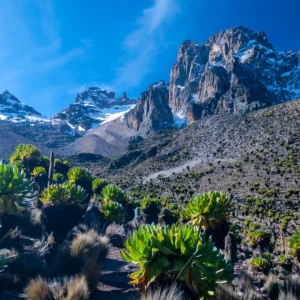
KAMWETI ROUTE — MOUNT KENYA

9 Days 8 Nights

The Kamweti Route Mount Kenya is the least-visited of the mountain's established approaches, beginning at Kamweti Gate on the southern slopes in Kirinyaga County. This long, forested route threads through undisturbed montane forest — one of the most pristine on the mountain's southern aspect — before ascending to the Afroalpine moorland and connecting with the summit circuit. It requires a special KWS permit, full camping equipment, and a highly experienced local guide. It is not suitable for first-time trekkers.

  • 4,985 m (16,355 ft) — Point Lenana
  • Jan–Feb and Jul–Sep (southern forest is very wet in rainy seasons)
  • Kamweti Gate, southern slopes — Kirinyaga County
  • Yes — KWS special use permit + park entry permit + climbing permit

ROUTE OVERVIEW

The Kamweti Route begins at Kamweti Gate on the southern slopes of Mount Kenya in Kirinyaga
County. It is the most remote gate access point on the mountain. The initial approach passes
through dense bamboo forest — a long, enclosed forest section that requires a guide with specific
knowledge of the southern approach.

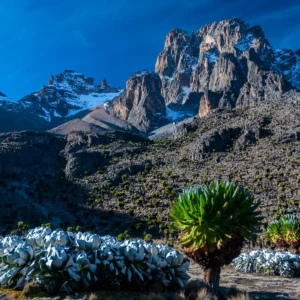
Above the bamboo, the route ascends through giant heath and Hagenia forest before transitioning
into the Afroalpine moorland. The forest is historically significant — this was one of the primary
approaches used by early colonial-era climbers and scientists in the late 19th and early 20th
centuries, before the Sirimon and Naro Moru routes were developed.

Wildlife presence in the forest is exceptional. The southern corridor supports leopard, elephant,
buffalo, black-and-white colobus, and Sykes monkey. Because the route is so rarely used, wildlife
encounters are undisturbed and relatively frequent. The absence of other trekkers makes this one
of the most immersive wildlife experiences available on any mountain approach in Kenya.

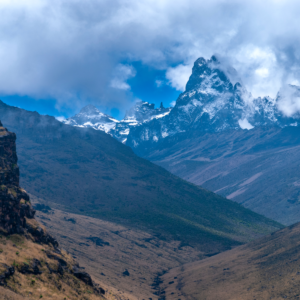
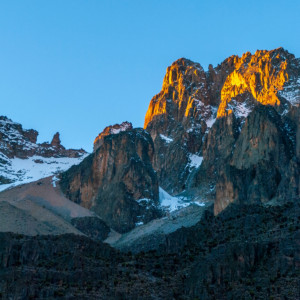
The Kamweti Route connects with the main summit circuit at the Tooth Col area, from where the
ascent to Point Lenana follows the upper mountain. The recommended combination is a Kamweti
ascent with Chogoria descent — a full south-to-east traverse that covers two completely different
aspects of the mountain in 7–9 days. There are no established hut facilities on the southern
approach — full camping equipment is mandatory throughout.

ROUTE HIGHLIGHTS

  • Dense bamboo and Hagenia forest on the southern approach — among the most intact montane forest on the entire mountain
  • Historic route — one of the earliest used by colonial-era climbers before the northern approaches were established
  • Leopard, elephant, buffalo, black-and-white colobus, and Sykes monkeys regularly encountered in the forest zones
  • Total isolation — very few trekkers use this route, making wildlife encounters more frequent and undisturbed
  • Connects with the summit circuit near Tooth Col — can be combined with Chogoria descent for a remarkable traverse
  • Exceptional conservation value — the southern forest is a critical wildlife corridor that most trekkers never see

WHAT'S INCLUDED

  • All KWS park entry, special use permit, and climbing permit fees
  • Mountain rescue fee
  • Highly experienced and KWS-licensed guide with Kamweti forest certification
  • Porters to carry all group camping equipment
  • Full camping equipment — tents, sleeping mats, dining tent, kitchen tent
  • All meals for the full duration
  • Emergency first aid kit, pulse oximeter, and extended first aid supplies
  • Return transfers between Embu/Kerugoya and Kamweti Gate
  • Summit certificate upon reaching Point Lenana

WHAT'S EXCLUDED

  • International and domestic flights to/from Kenya
  • Visa and eTA fees
  • Personal travel insurance (required — evacuation coverage essential on this route)
  • Tips and gratuities for guides, porters, and crew
  • Personal hiking gear — boots, trekking poles, waterproof layers, sleeping bag rated to -15°C
  • Altitude medication (Diamox) — consult your doctor before travel
  • Alcoholic beverages and personal purchases

Frequently Asked Questions

Who is the Kamweti Route suitable for?

Experienced trekkers only — those who have previously completed multiple multi-day mountain treks at altitude and are comfortable with remote, unstructured terrain. You must be self-sufficient in the field, confident in your physical condition, and prepared for a full expedition-style trip. This is not a route for anyone on their first or second mountain trek.

Do I need a special permit for the Kamweti Route?

Yes. A KWS special use permit is required in addition to park entry and climbing permits.
Permit applications must be submitted in advance through KWS. Your TripGenius Travel operator
manages this process — do not attempt to arrange it independently without operator support.

Is there any shelter on the Kamweti Route?

No. There are no established huts or bandas on the southern approach. Full camping equipment
is carried throughout the trek. TripGenius Travel provides all group camping gear — tents,
sleeping mats, mess tent, and kitchen equipment. You bring your personal sleeping bag (rated
to at least -15°C).

What is the recommended traverse combination for the Kamweti Route?

The Kamweti ascent combined with a Chogoria descent is the most rewarding traverse on the
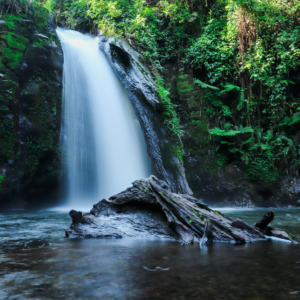
mountain. It covers the undisturbed southern forest on the way up and the dramatic Gorges Valley,
Lake Michaelson, and Nithi Falls on the descent — two completely different mountain characters
in one expedition, typically 7–9 days in total.

What gear should I bring?

A sleeping bag rated to at least -15°C — the southern approach is damp and cold. Full
waterproof outer layers, gaiters, ankle-support boots, trekking poles, headlamp, spare batteries,
first aid kit, water purification tablets, and a personal emergency whistle. UV sunglasses and
SPF 50+ for the upper mountain. All group camping gear is provided.