
LEMOSHO ROUTE — MOUNT KILIMANJARO

8 Days 7 Nights

The Lemosho Route Kilimanjaro is consistently rated by experienced operators as the finest overall route on the mountain. Beginning at Londorossi Gate (2,100 m) on the remote western slopes, this 7-to-8-day trek crosses the vast Shira Plateau, passes the Lava Tower (4,600 m), traverses the Barranco Wall, and follows the southern circuit to Uhuru Peak (5,895 m). The 8-day itinerary delivers the best acclimatisation profile and the highest documented summit success rates of any non-circuit route — approximately 90%.

  • 5,895 m (19,341 ft) — Uhuru Peak
  • Jan–Mar and Jun–Oct
  • Londorossi Gate, 2,100 m — ~81 km from Moshi (longest drive to gate)
  • ~70 km (ascent + Mweka descent)

ROUTE OVERVIEW

The Lemosho Route begins at Londorossi Gate (2,100 m), approximately 81 km from Moshi — the
furthest gate from town. A vehicle transfer through the forest to the trailhead at Lemosho
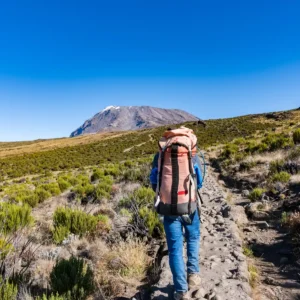
Glades reduces the walking distance and starts trekkers in genuine wilderness. Day one passes
through towering montane rainforest with elephant and buffalo in the lower sections.

Days two and three cross the Shira Plateau — a vast, open expanse at 3,800 m that was once
Kilimanjaro's third summit before it collapsed. The plateau gives unobstructed 360-degree views
of Kibo's summit cone and the Mawenzi peak. At Shira Camp, Lemosho briefly merges with the
Shira Route before the two diverge again.

Day four makes the signature acclimatisation move: climb north to Lava Tower (4,600 m) — a
20-metre volcanic pinnacle — for lunch, then descend to Barranco Camp (3,976 m). This is one
of the most effective altitude adaptation days on any Kilimanjaro route. Day five begins with
the Barranco Wall scramble, then follows the southern circuit to Karanga Camp and on to Barafu
high camp (4,673 m).

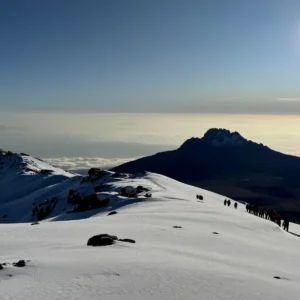
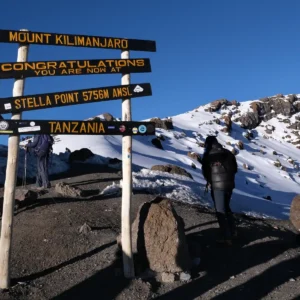
Summit night departs Barafu between midnight and 1 AM. The 5–7 hour ascent to Stella Point
(5,739 m) on the crater rim is steep and cold, with temperatures dropping to -15°C or below on
summit night. From Stella Point, a 1-hour walk along the crater rim reaches Uhuru Peak (5,895 m)
at sunrise. Descent follows the Mweka Route to Moshi, completing the full circuit in 8 days.

ROUTE HIGHLIGHTS

  • Shira Plateau crossing at 3,800 m — one of the largest high-altitude plateaus in Africa, traversed fully only by Lemosho and Northern Circuit
  • Pristine western rainforest approach with elephant and buffalo encountered in the lower forest zones
  • Lowest foot traffic of the main routes for the first 2–3 days before joining the southern circuit
  • Lava Tower (4,600 m) acclimatisation climb then descent to Barranco (3,976 m) — textbook climb-high-sleep-low execution
  • Barranco Wall scramble on Day 5 — the most dramatic section on the southern circuit
  • ~90% summit success rate on the 8-day itinerary — among the highest of any Kilimanjaro route
  • Full ecological zone sequence: rainforest, heathland, moorland, alpine desert, glacier summit

WHAT'S INCLUDED

  • All TANAPA park entry, camping, and rescue fees
  • Certified and TANAPA-licensed mountain guide for the full duration
  • Assistant guides (1 per 3 trekkers on summit night)
  • Porters to carry group equipment (ethically capped at 20 kg per porter)
  • Mountain chef and full catering crew
  • All camping equipment — tents, sleeping mats, dining tent, portable toilet tent
  • All meals from Day 1 dinner through departure day breakfast
  • Emergency supplemental oxygen on summit night
  • Pulse oximeter monitoring throughout the climb
  • Vehicle transfer through forest to Lemosho Glades trailhead
  • Return transfers between Moshi and park gates
  • Summit certificate upon reaching Uhuru Peak

WHAT'S EXCLUDED

  • International flights to Kilimanjaro International Airport (JRO)
  • Tanzania visa fees
  • Personal travel insurance (required — evacuation coverage essential)
  • Tips and gratuities for guides, porters, and crew
  • Personal hiking gear — boots, poles, gaiters, sleeping bag, layered clothing
  • Altitude medication (Diamox) — consult your doctor before travel
  • Alcoholic beverages and personal purchases
  • Hotel accommodation in Moshi before and after the climb

Frequently Asked Questions

Why is the Lemosho Route considered the best route on Kilimanjaro?

Three factors set Lemosho apart: its 8-day acclimatisation profile is the most thorough of
any non-circuit route; its western approach through remote rainforest and across the Shira
Plateau is the most scenically diverse; and its foot traffic is the lowest of the popular routes
for the first few days. Combined, these give the highest summit success rates and the most
complete mountain experience.

How does Lemosho compare to Machame?

Both routes share the southern circuit from Barranco onward and have the same summit approach.
The key differences: Lemosho takes 8 days vs Machame's 7, adding one more acclimatisation night;
Lemosho crosses the full Shira Plateau while Machame skirts its edge; and Lemosho is
significantly quieter for the first three days. Lemosho costs slightly more due to the additional
day. If budget allows, Lemosho is the stronger choice.

: What is the best time of year for the Lemosho Route?

January to March and June to October. January to March is the clearest and coldest, ideal for
summit photography. June to October is the most popular and slightly warmer. The Lemosho's
western approach makes it marginally wetter than the northern Rongai, but drier than the eastern
slopes. Avoid April to May and November when trail conditions deteriorate.

Do I need experience to climb the Lemosho Route?

No technical experience is required. The route is a high-altitude hike — steep at times, cold
on summit night, but with no rock climbing or roped sections (the Barranco Wall uses hands and
feet but no technical gear). You need solid general fitness and comfort hiking 6–8 hours per day
with a daypack. Previous hiking experience at 3,000 m+ is helpful but not mandatory.

What gear do I need for the Lemosho Route?

A sleeping bag rated to -15°C is non-negotiable — summit night temperatures can hit -20°C.
You also need: layered insulation (base layer, fleece, down jacket), waterproof shell, trekking
boots with ankle support, trekking poles, warm hat, balaclava, windproof gloves, gaiters,
headlamp, UV sunglasses, and SPF 50+. Most items can be rented in Moshi if you don't want to
travel with gear.