
Mabamba Swamp Shoebill Stork Birdwatching Tour from Entebbe

1 Day

A Mabamba Swamp shoebill birdwatching tour from Entebbe — motorised canoe across Lake Victoria to Uganda's most celebrated Ramsar Wetland for close-range observation of the Vulnerable shoebill stork in its papyrus habitat.

  • Year-round — early morning (6:00–10:00 a.m.) is the most productive birding window in all seasons; dry seasons (December–February and June–August) offer calmer lake conditions
  • Private vehicle to Nakiwogo Pier; motorised canoe to Mabamba; narrow canoe inside the wetland

Overview

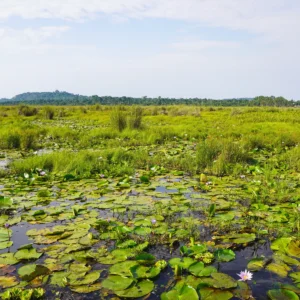
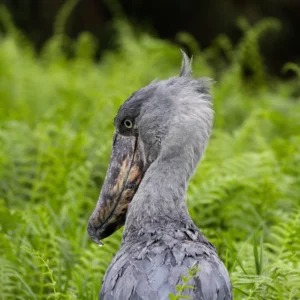
Mabamba Swamp is one of Africa's most celebrated birding destinations and the best place in Uganda — and arguably in all of East Africa — to observe the shoebill stork (Balaeniceps rex) at close range in a natural setting. The wetland sits on the northwestern shores of Lake Victoria, reached by a 30–45 minute motorised canoe crossing from Nakiwogo Pier in Entebbe. It is designated a Ramsar Wetland of International Importance for its exceptional biodiversity and its role as a critical habitat for globally significant bird populations.

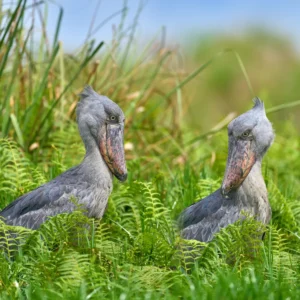
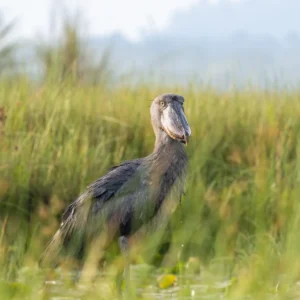
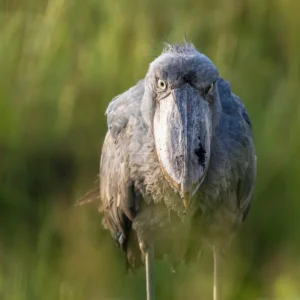
The shoebill (Balaeniceps rex) is a large, prehistoric-looking wading bird endemic to the freshwater swamps of tropical central and east Africa. It stands up to 1.5 metres tall, carries a wingspan of up to 2.5 metres, and is named for its extraordinary bill — as large as a Dutch clog, with a hooked tip designed to grip lungfish and other large prey. The IUCN classifies the shoebill as Vulnerable, with a global wild population estimated at 5,000–8,000 individuals. Uganda holds the world's largest known population, and Mabamba's papyrus swamp — where the bird hunts by standing motionless for extended periods before striking with explosive speed — consistently delivers some of the best shoebill sightings in Africa. Skilled local guides navigate the narrow papyrus channels and read the bird's behavioural cues with precision developed over years of daily exposure.

The wetland also supports over 260 bird species. Beyond the shoebill, a morning in Mabamba typically produces African jacanas walking on floating vegetation, malachite and pied kingfishers hovering over the channels, blue-breasted bee-eaters perching in the papyrus fringe, purple herons stalking the reed edge, grey-crowned cranes, African fish eagles calling overhead, and a parade of weavers, warblers, and sunbirds in the vegetation. For serious birders, Mabamba regularly produces sightings of species that require papyrus habitat — including the papyrus gonolek, white-winged warbler, and Carruthers's cisticola.

The experience is fundamentally different from a vehicle-based game drive: you sit low in a narrow canoe, the guide paddles silently through channels barely wider than the boat, and you are essentially at eye level with the wetland itself. The silence, the papyrus smell, and the sudden appearance of a 1.5-metre shoebill standing three metres from the canoe is one of the most distinctive wildlife encounters available anywhere in East Africa.

Trip Highlights

  • Close-range observation of the shoebill stork (*Balaeniceps rex*) in its natural papyrus swamp habitat — the best place in Africa for this encounter
  • Motorised canoe crossing of Lake Victoria from Nakiwogo Pier, Entebbe — scenic views across the world's second-largest freshwater lake by area
  • Navigate Mabamba's papyrus channels by canoe with a skilled local guide who reads shoebill behaviour precisely
  • Spot 260+ bird species including African jacanas, malachite kingfishers, blue-breasted bee-eaters, purple herons, and grey-crowned cranes
  • Mabamba Swamp is a Ramsar Wetland of International Importance — one of Africa's most significant protected wetland ecosystems
  • Perfect half-day activity before or after Entebbe International Airport arrivals/departures

Your Mabamba Swamp Shoebill Birdwatching Tour

  • Day
    01

    Mabamba Swamp Shoebill Birding Tour

    Your guide picks you up from your Entebbe hotel in the early morning — the 6:00–10:00 a.m. window is when birds are most active and the shoebill is most likely to be hunting and visible before retreating to shaded vegetation in the midday heat. Drive to Nakiwogo Pier on the Entebbe peninsula (10–20 minutes). Board the motorised canoe for the crossing of Lake Victoria's western arm to Mabamba's edge (30–45 minutes). The Lake Victoria crossing offers wide-angle views over the world's second-largest freshwater lake by area — a flat, glittering expanse with papyrus-fringed shores and fishing communities along the banks.

    Arrive at Mabamba and transfer to a narrow traditional canoe guided by a local Mabamba specialist. These guides navigate the wetland daily and track individual shoebill territories with the precision of someone who has watched the same bird for years. The canoe enters the papyrus channels — narrow passages barely wider than the boat, where the papyrus walls rise two metres on either side and the water is dark and still. Within the channels, the guide reads the tracks, droppings, and foraging signs that indicate where the shoebill has been hunting. When a shoebill is located — often standing motionless on a papyrus mat, waiting for a lungfish to surface — the guide manoeuvres the canoe within 3–8 metres and holds position while the bird hunts, rests, and occasionally looks directly at the visitors with its pale yellow eyes.

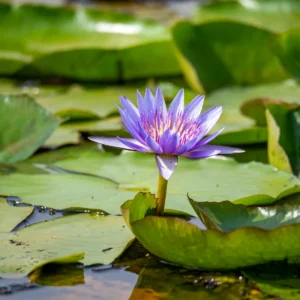
    After the shoebill encounter, the guide continues through the channels for general birding: African jacanas dancing on lily pads, malachite kingfishers a blur of electric blue, pied kingfishers hovering above the water before diving, purple herons fishing the papyrus edge, and weaver colonies in the overhanging vegetation. Papyrus specialist species — papyrus gonolek (a brilliant red-and-black bird), white-winged warbler, and Carruthers's cisticola — are among the targets for birders with a Uganda list. Return by canoe to the pier and motor back to Nakiwogo. Drive back to your Entebbe hotel, arriving by 11:00 a.m.–noon.

The Cost Includes

  • Private vehicle from Entebbe hotel to Nakiwogo Pier and return
  • Motorised canoe — Nakiwogo Pier to Mabamba Swamp and return (Lake Victoria crossing)
  • Local canoe guide inside Mabamba Wetland (navigates papyrus channels and locates shoebill)
  • Professional English-speaking birding guide throughout
  • Mabamba Wetland entry and local guide fee
  • Packed breakfast snacks and drinks in vehicle (Silver and Gold; Bronze bring own)
  • Extended canoe session (Silver)
  • Private canoe hire, binocular/field guide loan, post-tour species checklist, and Entebbe Botanical Gardens stop (Gold)
  • Hotel pickup and drop-off in Entebbe or Kampala
  • Bottled water in vehicle

The Cost Excludes

  • Meals (Bronze and Silver — bring your own snacks; Gold includes packed breakfast)
  • Tips and gratuities (recommended: USD 5–10/person for guide; USD 3–5 for local canoe guide)
  • Souvenirs
  • Uganda eVisa — apply at immigration.go.ug
  • Yellow fever vaccination certificate (mandatory for Uganda entry)
  • Travel insurance
  • Personal binoculars (available for loan in Gold Package)
  • Personal items