
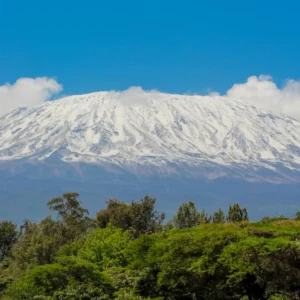
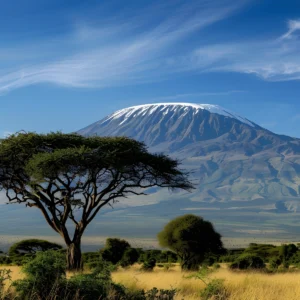
The Marangu Route begins at Marangu Gate (1,879 m), approximately 39 km from Moshi — the
closest gate to town. Day one climbs 5–7 hours through montane rainforest to Mandara Hut
(2,720 m). The rainforest here is rich in birdlife, including the hartlaub's turaco and
cinnamon-chested bee-eater. A short detour to the volcanic Maundi Crater is possible in the
afternoon.
Day two exits the forest into open moorland and heathland, passing the heath zone with giant
senecios (groundsels) and lobelias before reaching Horombo Hut (3,720 m) — the largest and
most social hut complex on the route. On the 6-day version, trekkers spend two nights here,
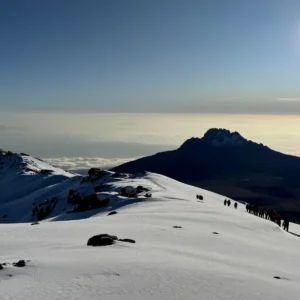
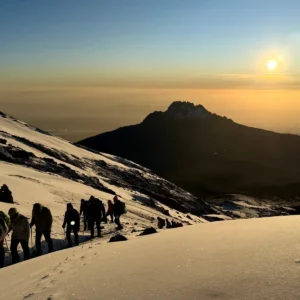
using the extra day for an acclimatisation walk toward Mawenzi Peak (5,149 m).
Day three (or four on 6-day) crosses The Saddle — a wide, flat, and wind-exposed moorland at
approximately 4,500 m separating Mawenzi from Kibo. This is one of the starkest and most
otherworldly landscapes on the mountain. Kibo Hut (4,703 m) is reached by early afternoon and
is used for rest before the midnight summit departure.
Summit night begins between midnight and 1 AM from Kibo Hut. The trail climbs steeply through
scree on the Kibo cone to Gilman's Point (5,685 m) on the crater rim — approximately 5–6 hours.
From Gilman's, the crater rim walk west to Uhuru Peak (5,895 m) takes a further 1.5–2 hours.
The same Marangu Route path is used for descent, returning to Marangu Gate on the final day.
ROUTE HIGHLIGHTS
-
The only Kilimanjaro route with permanent hut accommodation — Mandara Hut (2,720 m), Horombo Hut (3,720 m), and Kibo Hut (4,703 m)
-
No separate tent to pitch — huts provide shelter, communal dining, and a more predictable overnight experience
-
Gradual, well-maintained trail with the gentlest gradient of all the Kilimanjaro routes
-
Beautiful montane rainforest on the lower approach — a classic Kilimanjaro forest section with colobus and Sykes monkeys
-
The Saddle crossing: a wide, open 5 km moorland plateau between Mawenzi and Kibo peaks at ~4,500 m
-
Most affordable Kilimanjaro route — lower logistics cost makes it accessible for budget-conscious trekkers
-
Summit approach to Gilman's Point (5,685 m) then crater rim walk to Uhuru Peak (5,895 m)