
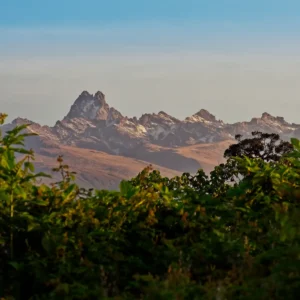
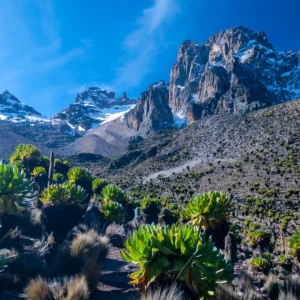
NARO MORU ROUTE — MOUNT KENYA

4 Days 3 Nights

The Naro Moru Route Mount Kenya is the shortest and most direct path to Point Lenana (4,985 m),
completing the ascent in as few as three days. Starting at Naro Moru Gate (2,400 m) on the
southwestern flank — approximately 180 km north of Nairobi — this route suits fit trekkers with
limited time and prior altitude experience. It is demanding, direct, and does not forgive slow
acclimatisation.

  • 4,985 m (16,355 ft) — Point Lenana
  • Naro Moru Gate, ~2,400 m — 180 km north of Nairobi via Nyeri
  • Jan–Feb and Jul–Sep (Vertical Bog becomes severe in wet season)
  • Yes — KWS park entry permit + climbing permit (via eCitizen)

ROUTE OVERVIEW

The Naro Moru Route begins at Naro Moru Gate (approximately 2,400 m) on the mountain's
southwestern flank. The first section follows a vehicle track through bamboo forest and upper
montane woodland to the Meteorological Station (3,050 m) — often driven rather than walked,
saving time. Huts and camping are available at Met Station.

Day two is the most demanding section. The trail climbs steeply through heath and open moorland
before hitting the infamous Vertical Bog — a long, steep band of waterlogged tussock grass that
can be knee-deep in mud during or after the rains. Beyond the bog lies the Devil's Staircase, a
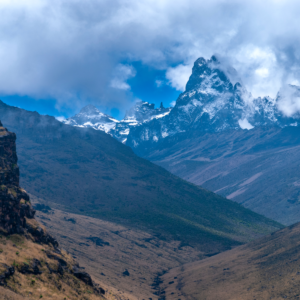
sustained rocky ascent to Mackinder's Camp (4,200 m). The camp sits at the entrance to the
Teleki Valley with direct views up to the main peaks.

Summit night launches from Mackinder's Camp between 2–3 AM. The route ascends through the
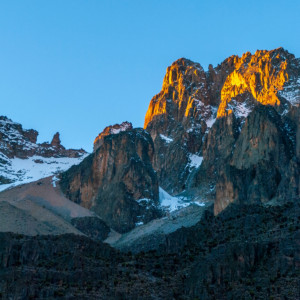
Teleki Valley, passes the Austrian Hut (4,790 m), and continues via the South Face to Point
Lenana (4,985 m). Sunrise from Lenana is exceptional — the Lewis Glacier and twin peaks frame
the view in the early light.

Because altitude is gained very rapidly on this route, the risk of altitude sickness is higher
than on Sirimon or Chogoria. A 4-day version adding an extra acclimatisation night at Met Station
is strongly recommended for most trekkers. The Naro Moru Route is also the standard descent route
for those who ascend via Sirimon, making it efficient for traverse combinations.

ROUTE HIGHLIGHTS

  • Fastest route to Point Lenana — summit achievable in 3 days for experienced high-altitude trekkers
  • The Vertical Bog: a genuinely challenging muddy moorland ascent that tests footwork and resolve
  • Hut accommodation available at Met Station (3,050 m) and Mackinder's Camp (4,200 m) — no tent required
  • Wide Teleki Valley panorama with direct sightlines to the Tyndall Glacier
  • Austrian Hut at 4,790 m — one of the highest shelter points on the mountain
  • Closest gate to Nairobi — 180 km, approximately 3–4 hours by road via Nyeri
  • Standard descent route for Sirimon and Chogoria ascents — adds traverse variety to any combination

WHAT'S INCLUDED

  • All KWS park entry and climbing permit fees
  • Mountain rescue fee
  • Certified and KWS-licensed mountain guide for the full duration
  • Porters to carry group equipment
  • Hut accommodation at Met Station and Mackinder's Camp (or camping where preferred)
  • All meals on the mountain
  • Emergency first aid kit and pulse oximeter
  • Return transfers between Naro Moru town and park gate
  • Summit certificate upon reaching Point Lenana

WHAT'S EXCLUDED

  • International and domestic flights to/from Kenya
  • Visa and eTA fees
  • Personal travel insurance (required — must cover mountain rescue)
  • Tips and gratuities for guides, porters, and crew
  • Personal hiking gear — boots, trekking poles, layers, sleeping bag
  • Altitude medication (Diamox) — consult your doctor before travel
  • Alcoholic beverages and personal purchases

Frequently Asked Questions

How hard is the Vertical Bog on the Naro Moru Route?

The Vertical Bog is one of the most physically demanding non-technical sections on any Mount
Kenya route. It is a steep, waterlogged stretch of tussock moorland roughly 1–2 hours long. In
dry season it is firm enough to navigate with care. In wet season — March to May and October to
November — it becomes deeply muddy and exhausting. Waterproof gaiters and strong ankle-support
boots are not optional on this section.

Is the Naro Moru Route suitable for first-time high-altitude trekkers?

It is not the recommended first choice. The rapid altitude gain — from gate to Mackinder's
Camp in under two days — gives your body very little time to acclimatise. First-timers above
3,500 m should use the Sirimon Route instead. If you have previous experience above 4,000 m and
are short on time, Naro Moru is a solid choice with proper preparation.

What is the best time of year to hike the Naro Moru Route?

January to February and July to September. Avoid the wet seasons — March to May and October
to November — when the Vertical Bog becomes severely muddy and trail conditions deteriorate. The
mountain can be climbed year-round, but the dry seasons give the highest summit success rates
and safest conditions on this route.

Do I need a permit to hike the Naro Moru Route?

Yes. A KWS park entry permit and climbing permit are mandatory. These are obtained digitally
via the eCitizen portal or arranged through your licensed TripGenius Travel operator. Fees are
charged per 24-hour period — multi-day climbers pay for each day in the park.

What gear should I bring?

Waterproof gaiters are essential for the Vertical Bog section — they are not standard kit but
make a real difference here. Beyond that: layered insulation, waterproof shell jacket and trousers,
trekking boots with solid ankle support, trekking poles, headlamp, sleeping bag rated to -10°C,
and SPF 50+ sunscreen. Gear rental is available in Naro Moru town.