
SHIRA ROUTE — MOUNT KILIMANJARO

7 Days

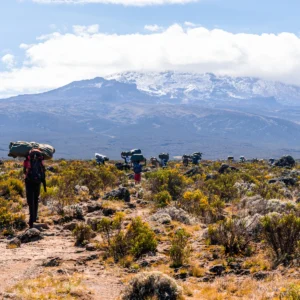
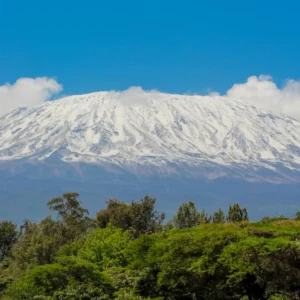
The Shira Route Kilimanjaro is a western approach that begins at Londorossi Gate (2,100 m) and was the original western route before Lemosho was developed as a superior alternative. Its defining characteristic — and its main risk — is that vehicles drive trekkers to a starting elevation of approximately 3,500 m, skipping the forest acclimatisation section that lower-starting routes provide. This compressed start increases altitude sickness risk but delivers immediate access to the dramatic Shira Plateau. It is best suited to trekkers with good prior altitude history.

  • 5,895 m (19,341 ft) — Uhuru Peak
  • Jan–Mar and Jun–Oct
  • Londorossi Gate, 2,100 m — vehicle drives to ~3,500 m start point
  • ~53 km (Shira plateau start + Mweka descent)

ROUTE OVERVIEW

The Shira Route begins at Londorossi Gate (2,100 m) — the same gate as Lemosho — but instead
of walking through the rainforest, trekkers board a vehicle that drives up to approximately
3,500 m, where the walking begins on the Shira Plateau. Day one is spent on the plateau itself,
reaching Shira 1 Camp (3,504 m) or Shira 2 Camp (3,840 m) without the forest acclimatisation
buffer that Lemosho's lower start provides.

Starting at 3,500 m on Day 1 — sleeping at this altitude on the very first night — is the
route's most significant risk factor. Most bodies have not had time to begin adapting to altitude
after a long international journey and a vehicle transfer. Trekkers with proven acclimatisation
ability above 3,500 m handle this well; those without that history are at measurably higher AMS
risk on the Shira Route than on any other western approach.

From Shira Camp, the route merges fully with Lemosho and follows the identical southern circuit
path: Lava Tower acclimatisation climb (4,600 m), descent to Barranco Camp (3,976 m), Barranco
Wall scramble, and the progression along the southern circuit to Barafu high camp (4,673 m).
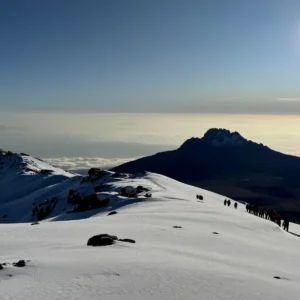
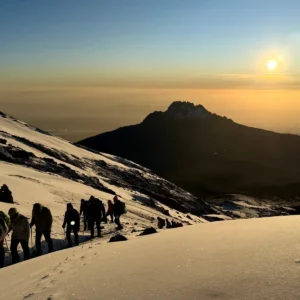
Summit night follows the Machame/Lemosho approach to Stella Point (5,739 m) and Uhuru Peak
(5,895 m).

Descent follows the Mweka Route. Total duration is 7 days on the standard Shira itinerary. For
trekkers choosing between Shira and Lemosho, Lemosho is consistently the stronger choice for
the same duration — the additional forest acclimatisation day it provides makes a meaningful
difference to summit success rates. The Shira Route remains viable for experienced trekkers with
good altitude history who want the western plateau entry without the longer Lemosho forest
approach.

ROUTE HIGHLIGHTS

  • Immediate access to the Shira Plateau at 3,500 m on Day 1 — the most direct western plateau approach of any route
  • Full Shira Plateau crossing with unobstructed views of the Kibo summit cone from the west
  • Moir Hut (4,200 m) acclimatisation option — a camp shared only with Northern Circuit trekkers
  • Lava Tower (4,600 m) included on the main circuit — a critical altitude adaptation point on the southern circuit
  • Barranco Wall on Day 4 or 5 — the classic southern circuit scramble shared by Machame, Lemosho, and Northern Circuit
  • Merges with Lemosho from Shira Camp onward — same southern circuit scenery with a different first day
  • Viable option for trekkers with strong prior altitude experience who want the western approach without the Lemosho forest section

WHAT'S INCLUDED

  • All TANAPA park entry, camping, and rescue fees
  • Certified and TANAPA-licensed mountain guide for the full duration
  • Assistant guides on summit night
  • Porters to carry group equipment (ethically capped at 20 kg per porter)
  • Mountain chef and full catering crew
  • All camping equipment — tents, sleeping mats, dining tent, portable toilet tent
  • All meals from Day 1 dinner through departure day breakfast
  • Emergency supplemental oxygen on summit night
  • Pulse oximeter monitoring throughout the climb
  • Vehicle transfer from Londorossi Gate to the Shira Plateau trailhead (~3,500 m)
  • Return transfers between Moshi and park gates
  • Summit certificate upon reaching Uhuru Peak

WHAT'S EXCLUDED

  • International flights to Kilimanjaro International Airport (JRO)
  • Tanzania visa fees
  • Personal travel insurance (required — must cover high-altitude trekking and evacuation)
  • Tips and gratuities for guides, porters, and crew
  • Personal hiking gear — boots, poles, gaiters, sleeping bag (-15°C rated), warm layers
  • Altitude medication (Diamox) — consult your doctor before travel
  • Alcoholic beverages and personal purchases
  • Hotel accommodation in Moshi before and after the climb

Frequently Asked Questions

How does the Shira Route compare to the Lemosho Route?

Both start at Londorossi Gate and share the same southern circuit from Shira Camp onward —
the summit approach is identical. The difference is the first day: Lemosho walks through pristine
rainforest from 2,100 m, giving a gradual altitude gain and a critical acclimatisation buffer.
Shira skips the forest by vehicle and starts walking at 3,500 m, removing that buffer. For most
trekkers, Lemosho is the stronger choice for the same price and similar duration.

Who is the Shira Route suitable for?

Experienced trekkers who have previously spent time above 3,500 m and know their body
acclimatises well at altitude. If you have summited Kilimanjaro via another route or trekked
above 4,000 m successfully before, the Shira's compressed start is manageable. For first-time
Kilimanjaro trekkers, the Lemosho is a safer and more enjoyable choice.

What is the AMS risk on the Shira Route compared to other routes?

Higher than Lemosho, similar to the Rongai. Sleeping at 3,500 m on Day 1 after arriving from
sea level is a significant physiological challenge. Your guide will conduct pulse oximeter checks
from the first night and monitor for headache, nausea, and poor sleep — the classic early AMS
signs. Hydration, slow pace, and Diamox (if prescribed) are your best tools. If symptoms are
severe, descent is mandatory.

What is the best time of year for the Shira Route?

January to March and June to October. The exposed Shira Plateau is cold and windswept at any
time of year — windproof layers are important from Day 1. Avoid the wet seasons when the Plateau
becomes boggy and the trail approach deteriorates.

What gear do I need?

Because you start at 3,500 m on Day 1, your warm gear must be accessible from the first
afternoon — do not pack it deep in your kit bag. Essential from Day 1: fleece mid-layer,
windproof shell, warm hat, and gloves. Full gear: sleeping bag rated to -15°C, layered insulation,
waterproof shell and trousers, trekking boots, poles, balaclava, headlamp, UV sunglasses, and
SPF 50+.