
TIMAU ROUTE — MOUNT KENYA

6 Days 5 Nights

The Timau Route Mount Kenya approaches the mountain from its quiet northern side, starting near Timau town on the Nanyuki–Meru road at approximately 2,500 m. This is one of the least-used routes on the mountain, passing through open Afroalpine heath and moorland before joining the Sirimon trail in the upper mountain zone near Shipton's Camp. It requires a special KWS permit and a guide with knowledge of the northern sector. It is best used as part of a longer circuit traverse rather than as a standalone itinerary.

  • 4,985 m (16,355 ft) — Point Lenana
  • Near Timau town, northern slopes — ~2,500 m on Nanyuki–Meru road
  • Jan–Feb and Jul–Sep
  • Yes — KWS special use permit + park entry permit + climbing permit

ROUTE OVERVIEW

The Timau Route begins near Timau town on the Nanyuki–Meru road at approximately 2,500 m.
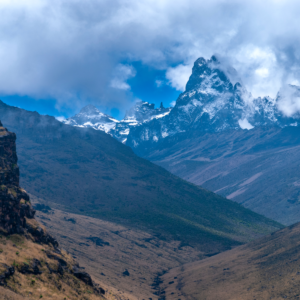
From here, the trail climbs directly into open heath and Afroalpine moorland — there is less
dense forest on this northern approach compared to the Sirimon or Burguret routes.

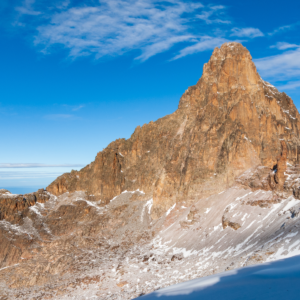
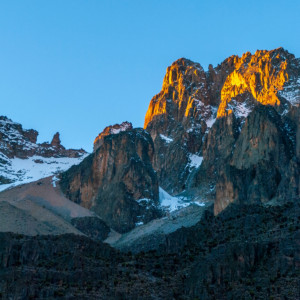
The northern approach gives excellent early views of the mountain's glaciated upper faces and
the sweeping Laikipia plateau. Eland, hyrax, and a variety of Afroalpine birds — including
alpine sunbirds and thick-billed ravens — are commonly encountered in the moorland zone.

The Timau Route joins the main Sirimon trail in the upper mountain area near Shipton's Camp
(4,200 m), from where the summit push to Point Lenana (4,985 m) follows the standard pre-dawn
route. This makes the Timau most effective as the ascent leg of a Timau–Sirimon or
Timau–Chogoria traverse.

The route is not well-marked and a guide with specific northern sector experience is essential.
It is not currently offered as a standalone commercial route by most operators. TripGenius Travel
can arrange bespoke itineraries for experienced trekkers who want to explore this sector of the
mountain. Duration is typically 5–6 days for a full traverse.

ROUTE HIGHLIGHTS

  • Quiet northern perspective on the mountain — virtually no other trekkers on the approach
  • Open Afroalpine moorland from the start — sweeping views of the Laikipia plateau below
  • Excellent sightings of moorland fauna — eland, hyrax, and Afroalpine birds including sunbirds and ravens
  • Early and unobstructed views of the mountain's glaciated upper section from the northern approach angle
  • Joins Sirimon trail near Shipton's Camp — seamless integration into a full cross-mountain circuit
  • Suitable for adding variety to experienced trekkers already familiar with the three main routes

WHAT'S INCLUDED

  • All KWS park entry, special use permit, and climbing permit fees
  • Mountain rescue fee
  • Certified and KWS-licensed mountain guide with northern sector experience
  • Porters to carry all group camping equipment
  • Full camping equipment — tents, sleeping mats, dining tent, kitchen tent
  • All meals for the full duration
  • Emergency first aid kit and pulse oximeter
  • Return transfers between Nanyuki and Timau trailhead
  • Summit certificate upon reaching Point Lenana

WHAT'S EXCLUDED

  • International and domestic flights to/from Kenya
  • Visa and eTA fees
  • Personal travel insurance (required — must cover mountain rescue)
  • Tips and gratuities for guides, porters, and crew
  • Personal hiking gear — boots, trekking poles, layers, sleeping bag
  • Altitude medication (Diamox) — consult your doctor before travel
  • Alcoholic beverages and personal purchases

Frequently Asked Questions

Who is the Timau Route suitable for?

Experienced trekkers who have previously completed one of the three main routes (Sirimon,
Chogoria, or Naro Moru) and want to explore an undocumented sector of the mountain. It is not
suitable for first-time trekkers on Mount Kenya. Navigation competence and comfort with remote
terrain are required.

Do I need a special permit for the Timau Route?

Yes. The Timau Route requires a KWS special use permit in addition to the standard park entry
and climbing permits. Your TripGenius Travel operator arranges all permits in advance as part of
the booking process.

Can the Timau Route be combined with other routes?

Yes — and this is strongly recommended. The Timau is most rewarding as the ascent leg of a
circuit, with descent via Sirimon or Chogoria. A full Timau–Chogoria traverse gives an
exceptional cross-mountain experience covering the northern and eastern aspects of the mountain.

What is the best time to hike the Timau Route?

January to February and July to September. The northern moorland is exposed and can be very
cold and windy in the wet seasons. Clear conditions are essential for navigation on this
less-marked route.

What gear should I bring?

Wind protection is more important on the exposed northern approach than on the forested western
routes — a windproof outer layer is essential even in dry season. Otherwise: layered insulation,
trekking boots, poles, headlamp, sleeping bag rated to -10°C, sunscreen, and UV sunglasses. All
group camping equipment is provided.