
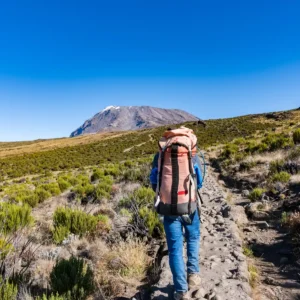
The Umbwe Route begins at Umbwe Gate (1,640 m), 24 km from Moshi — the closest gate on the
mountain. The first day climbs a steep forest ridge on a narrow trail where tree roots provide
the main footholds on the most vertical sections. The forest is dense, untouched, and receives
virtually no traffic. Umbwe Cave Camp (2,940 m) is reached after 5–6 hours.
Day two continues up the same ridge with the gradient intensifying above the forest line into
moorland. By the end of day two, trekkers reach Barranco Camp (3,976 m) — the same camp used
by Machame and Lemosho trekkers, who arrive here on their third or fourth day. That gap —
reaching Barranco in two days versus three or four — illustrates exactly how steep Umbwe is and
why altitude sickness risk is significantly higher on this route.
From Barranco, the Umbwe Route merges fully with the southern circuit. Day three climbs the
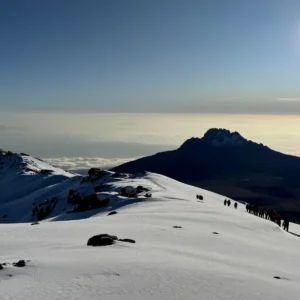
Barranco Wall and continues to Karanga or Barafu high camp (4,673 m). Summit night follows the
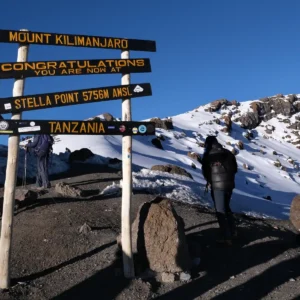
standard Machame/Lemosho approach via Stella Point (5,739 m) to Uhuru Peak (5,895 m). An
alternative via the Western Breach is technically more demanding and is offered as a private
arrangement for climbers with relevant experience.
The compressed altitude gain on days one and two is the Umbwe Route's defining characteristic
and its main hazard. Adding an acclimatisation day at Lava Tower (4,600 m) before descending to
Barranco significantly improves the safety profile and is strongly recommended. Descent follows
the Mweka Route.
ROUTE HIGHLIGHTS
-
The steepest and most direct route on Kilimanjaro — gains altitude faster than any other path on the mountain
-
Closest gate to Moshi at 24 km — minimal transfer time compared to western and northern routes
-
Complete solitude: one of the least-used routes on the mountain with approximately 500 trekkers per year
-
Dense, wild rainforest ridge in the lower section — tree roots act as handholds and natural steps on the steepest sections
-
Joins the southern circuit at Barranco Camp — Barranco Wall and Lemosho/Machame summit approach from Day 3 onward
-
Optional Western Breach variation for experienced mountaineers wanting a non-standard summit approach
-
The fastest possible ascent profile — suited to experienced high-altitude trekkers with proven acclimatisation history