
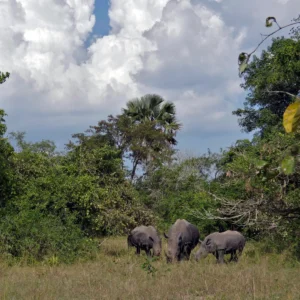
Ziwa Rhino Sanctuary Day Trip from Kampala or Entebbe — Rhino Tracking on Foot

1 Day

A full-day Ziwa Rhino Sanctuary day trip from Kampala — track Southern White Rhinos on foot with UWA-trained rangers through 70 km² of savannah in Uganda's only rhino sanctuary, where every individual rhino is known by name.

  • Year-round — rhinos are present in all seasons; dry months (December–February and June–August) offer better savannah visibility and drier tracking conditions
  • Rhino tracking: 1–2 hours on foot through flat savannah (easy pace, suitable for all fitness levels)

Overview

Uganda's rhinos were hunted to complete extinction in the national parks during the political instability of the 1970s and 1980s. By the early 1980s, not a single wild rhino remained in the country. Ziwa Rhino and Wildlife Ranch is where that story is being reversed.

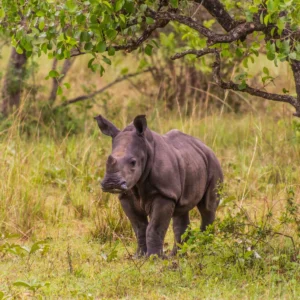
Ziwa Rhino Sanctuary was established in 2005 as a protected breeding and reintroduction project aimed at restoring rhinos to Uganda's national parks. The sanctuary started its conservation journey with only 6 rhinos — 4 relocated from Solio Ranch in Kenya and 2 translocated from Disney's Animal Kingdom in Florida — and now holds over 32 Southern White Rhinos. The sanctuary covers over 70 square kilometres of savannah and bushland, jointly managed by the Uganda Wildlife Authority and the Rhino Fund Uganda, with the ultimate goal of reintroducing rhinos back into Uganda's national parks where they once thrived.

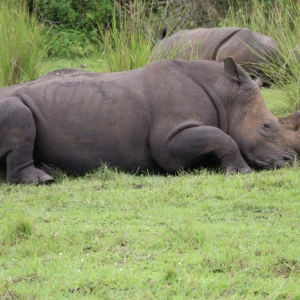
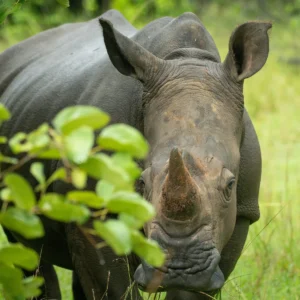
All the rhinos at Ziwa are free to move around the 27 square miles within the ranch. Well-trained rangers guide visitors through the bush to wherever the rhinos are at the time, entering the territory of the Southern White Rhinos on foot. Every individual rhino in the sanctuary is known to the rangers by name — a name given based on their personality, history, or the circumstances of their arrival. When you meet a rhino at close range on the savannah, your guide tells you its name, its family relationships, and its story. It is possible to get very close to these magnificent creatures — far closer than a vehicle-based game drive would allow — in what is genuinely one of Uganda's most intimate wildlife encounters.

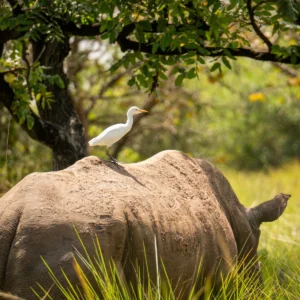
In addition to white rhinos, visitors may encounter Uganda kob, bushbuck, warthogs, vervet monkeys, and a wide variety of bird species including the shoebill stork. Over 300 bird species can be spotted here, including the rare Shoebill stork. The sanctuary's position on the Kampala-Gulu highway makes it a natural stop for anyone travelling to or from Murchison Falls National Park.

Because of Ziwa Rhino Sanctuary, Uganda is one of the few African countries where all of the Big Five — lion, leopard, elephant, buffalo, and rhinoceros — can be seen. Lions and the other four are present in parks like Murchison Falls and Kidepo Valley. The rhino is found only here.

Trip Highlights

  • Track Southern White Rhinos on foot with UWA-trained rangers — getting closer to rhinos than any vehicle-based game drive allows
  • Learn each rhino's individual name, personality, and conservation story from your guide
  • Witness the living results of Uganda's rhino reintroduction programme — from 0 wild rhinos in 1983 to 32+ and growing
  • Spot the rare Shoebill stork, Uganda kob, bushbuck, warthogs, and over 300 bird species in the 70 km² sanctuary
  • Complete Uganda's Big Five — the rhino at Ziwa joins lions, leopards, elephants, and buffalos available in other parks
  • All sanctuary entry fees and rhino tracking fees included; private transport throughout

Your Ziwa Rhino Sanctuary Day Trip from Kampala

  • Day
    01

    Kampala to Ziwa Rhino Sanctuary and Back

    Your private vehicle departs from your Kampala or Entebbe hotel in the early morning and drives north on the Kampala-Gulu highway through Kayunga and Kakooge. Arrive at Ziwa Rhino and Wildlife Ranch (approximately 3 hours from Kampala) and check in at reception for the safety briefing. Rhinos can weigh up to 350 stone and can run much faster than any human — the rangers are extremely well trained, and your safety is their first priority. It is important to listen to the safety briefing and obey the rules in order to remain safe.

    Your UWA ranger leads the tracking on foot into the sanctuary's 70 km² of open savannah. All rhinos at Ziwa are free to move around the ranch, so it is often necessary to drive to the areas where the rhinos are before continuing the trek on foot. Rangers communicate with colleagues across the sanctuary via radio — since every individual rhino is GPS-monitored and known by name, the team is aware of each animal's position before the tracking begins. Once a rhino family is located, the group approaches on foot to a safe viewing distance of approximately 7–10 metres. Your guide explains each rhino's name, its place in the family group, its origin story (from Solio Ranch Kenya, Disney's Animal Kingdom, or born in the sanctuary), and the broader conservation significance of what you're witnessing: the slow recovery of a species from total national extinction.

    Tracking usually takes 1 to 2 hours depending on the location of the rhinos. Early morning and late afternoon are the best times when the weather is cool and rhinos are more active. After the tracking, you have free time to explore the sanctuary grounds, visit the Shoebill hide (the sanctuary is one of Uganda's best spots for a Shoebill stork sighting), or take a guided birding walk. Warthogs, Uganda kob, bushbuck, and waterbuck are regularly seen in the sanctuary's open savannah areas.

    After the sanctuary visit, begin the return drive to Kampala or Entebbe, arriving in the mid-to-late afternoon.

The Cost Includes

  • Private vehicle transport from Kampala or Entebbe to Ziwa Rhino Sanctuary and return
  • Ziwa sanctuary entry and rhino tracking fee (~USD 50/adult, USD 25/child under 12 — included)
  • UWA-trained ranger-guided rhino tracking on foot inside the sanctuary
  • Professional English-speaking driver-guide throughout
  • Bottled water in vehicle
  • Kampala or Entebbe hotel pickup and drop-off
  • Packed lunch (Silver and Gold packages; not included in Bronze)
  • Canoe ride — Lugogo Swamp (Gold Package only; ~USD 25–30/person fee included)
  • Guided specialist birding walk (Silver and Gold — targeting Shoebill stork and sanctuary specials)

The Cost Excludes

  • Meals and drinks (Bronze Package — café available on site; bring your own packed food)
  • Uganda eVisa — apply at immigration.go.ug before travel (EAC citizens can use national ID)
  • Yellow fever vaccination certificate — mandatory for Uganda entry
  • Travel insurance (recommended)
  • Tips for guide and rangers (recommended: USD 5–10/person for guide; USD 3–5/person for UWA ranger)
  • Personal items and souvenirs
  • Additional sanctuary activities not listed (night walk — USD 20–25/person; additional guided nature walk — USD 15–20/person; available on request)

Frequently Asked Questions

How reliable are the rhino sightings at Ziwa?

Extremely reliable — more so than any open-park game drive in Africa. Every rhino in Ziwa's 70 km² sanctuary is individually GPS-tracked and known to the ranger team by name and current location. Rangers communicate via radio before the tracking begins and know approximately where each family group is. While no wildlife sighting is ever a mathematical certainty (a rhino in thick bush may be visually obstructed), trained rangers lead small groups through the sanctuary, following rhino footprints and droppings to locate the animals, and the managed nature of the sanctuary means nearly every group finds rhinos on every visit. This is categorically different from hoping to spot a rhino in a large national park.

Are these wild rhinos or captive animals?

Neither — and both. When visiting Ziwa you wouldn't know you are in a sanctuary — at 70 square kilometres the area that the rhinos can roam through is vast. It is nothing like a zoo or even a safari park; it feels like savannah wilderness. The rhinos are free to move throughout the entire 70 km² of the sanctuary's electric-fenced perimeter, living in natural family groups, eating wild grass, and behaving as rhinos would in the wild. They are not fed, not contained in enclosures, and not trained. The "managed" element is the fence that protects them from poaching — inside that fence, their lives are fully wild.

Why are the rhinos named, and can I meet a specific one?

Each rhino in Ziwa's population is given an individual name based on their arrival story, personality, or the community that contributed to their conservation. The naming serves both a conservation record-keeping function and a powerful public engagement purpose — it is much easier for visitors to care deeply about an individual named rhino than about "a rhino." Your ranger will introduce you to the animals by name and share their family histories. If you have a specific rhino you'd like to try to find, notify your TripGenius Travel agent when booking and the ranger team will note the preference.

Is Ziwa a good stopover on the way to Murchison Falls?

Yes — this is the most common way Ziwa is used in Uganda safari itineraries. Ziwa Rhino Sanctuary's strategic location along the main route to Murchison Falls National Park means travelers heading north naturally pass near Ziwa, making the sanctuary geographically convenient and logistically efficient. A combined Ziwa + Murchison Falls circuit is one of Uganda's most popular 3–4 day safari formats — you track rhinos at Ziwa on Day 1, continue north to Murchison Falls that afternoon, spend 2 days on game drives and the Nile boat cruise, and return south. Contact your TripGenius Travel agent to arrange the combined itinerary.

What should I wear for rhino tracking?

Closed shoes, long pants, and insect repellent are recommended, along with neutral earth-toned clothing (khaki, olive, beige). Avoid military-style or camouflage patterns, which are prohibited in Uganda's wildlife areas. Bring a hat and sunscreen — the sanctuary is open savannah with limited shade. The terrain is flat and the pace is gentle; this is accessible to visitors of all fitness levels.