
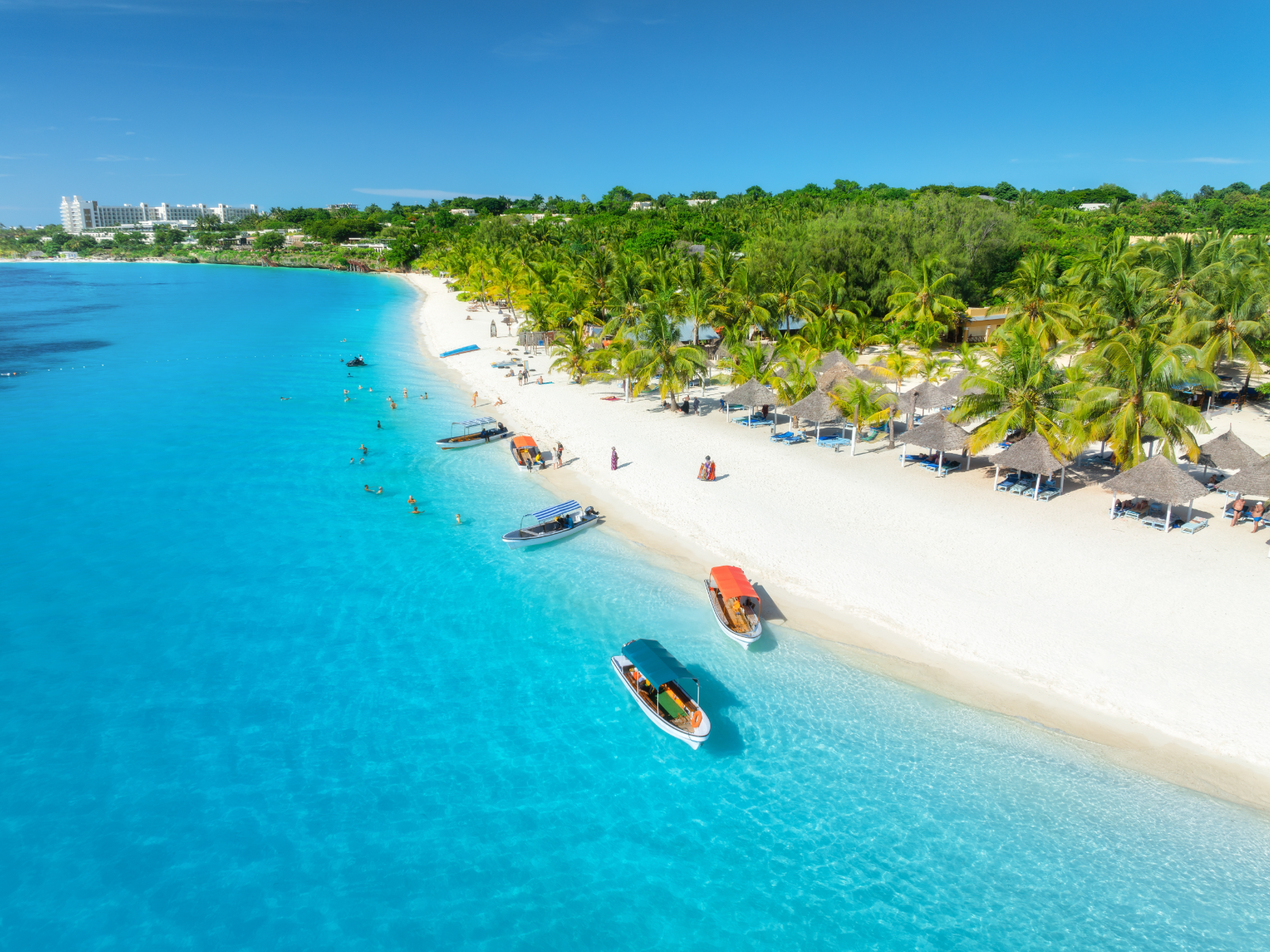
The thing that surprises most Kenyans is how close it actually is. Zanzibar sits 90 minutes from Jomo Kenyatta by direct flight — shorter than driving to Nakuru on a bad day. Yet for most people, it stays on the someday list.
This Zanzibar travel guide is written for two audiences: Kenyans who have been meaning to go but haven’t pulled the trigger, and international visitors finishing a wildlife safari who want a proper beach leg rather than rushing back to a departure airport. Both groups end up in the same place — a semi-autonomous Tanzanian archipelago off the East African coast, called the Spice Island, with beaches that look photoshopped and a UNESCO-listed old town that no other city on the continent quite matches.
Here is everything you need to plan it properly: how to get there, the entry paperwork, which beach to base yourself at, what Stone Town is actually worth, and the honest answer on timing.
Why Zanzibar Works as a Safari Add-On
The geography makes the combination almost too easy. Finish a safari at the Serengeti, the Maasai Mara, or Amboseli and you are already halfway to the coast. A short direct flight puts you on the island without doubling back to Nairobi. The contrast then works in your favour — safari means early mornings, game drives, dust, and days spent scanning the horizon. Zanzibar flips every variable. You wake up when you want, the water is warm, the food is fresh seafood, and the pace is set by tides rather than radio calls from a spotter.
How to Get to Zanzibar from Nairobi
Direct Flights from JKIA
The route from Jomo Kenyatta International Airport (NBO) to Abeid Amani Karume International Airport (ZNZ) is well served. As of 2026, Kenya Airways, Precision Air, Air Tanzania, Flightlink, and Skyward Express all operate on this corridor, with more than 200 scheduled departures per week. Average flight time is 1 hour 30 minutes to 1 hour 40 minutes.
Kenya Airways runs the most frequent service. Round-trip fares in economy start from around KES 79,000, though prices climb during peak windows — Christmas, Easter, and July through August. The cheapest months to fly are June and October, both of which fall inside Zanzibar’s dry season. That alignment matters: you do not have to choose between value and weather. Budget carriers like Flightlink tend to undercut mainline airlines on base fares for travellers willing to watch departure times.
As a general rule, book four to six weeks ahead. On high-demand dates, waiting until two weeks out means paying a meaningfully higher fare for the same seat.
Getting Around Once You Arrive
Zanzibar’s main island — Unguja — stretches about 85 kilometres north to south and 30 kilometres at its widest. It is not a big island, which makes moving between areas straightforward once you understand the options.
Dala-dalas (shared minibuses) connect the major centres and are the cheapest way to travel between towns for those comfortable navigating local routes. Taxis are easy to find at the airport and in Stone Town, with price negotiation standard practice. Private airport transfers are the most predictable option if you are arriving with luggage and a tight schedule.
For day trips and inter-beach moves, most hotels and tour operators can arrange vehicle hire. Motorbike taxis — called piki-pikis locally — are common in town areas for short distances and are best used for quick errands rather than luggage hauling.
Entry Requirements — What Kenyans and International Visitors Need to Know
For Kenyan Citizens
Kenyans enter Zanzibar visa-free as East African Community nationals, with stays permitted up to 90 days. No visa application or fee is required.
However, two additional requirements apply regardless of nationality. The first is mandatory Zanzibar travel insurance. Since October 2024, all foreign visitors must purchase a policy from the Zanzibar Insurance Corporation (ZIC) before arriving. The cost is USD 44 per person and the policy covers stays of up to 92 days. Your existing personal travel insurance does not substitute for this — it is a separate government-mandated entry condition. Buy it through the official Zanzibar government insurance portal before you fly; do not leave it to the airport.
The second is a yellow fever certificate. Kenya is classified as a yellow fever risk country, which means Kenyan travellers must carry a valid yellow fever vaccination certificate to enter Tanzania. Bring the original card — a phone photo is not accepted at immigration.
For International Visitors
Most nationalities require a Tanzania visa. Citizens of other EAC member states — Uganda, Rwanda, Burundi, South Sudan — are visa-exempt, but travellers from Europe, the Americas, Asia, and most of the rest of Africa need either an eVisa or a visa on arrival. The standard single-entry tourist visa costs USD 50. US citizens pay USD 100 and must apply for a multiple-entry visa.
Apply in advance through the official Tanzania eVisa portal. Processing takes up to 10 working days. On-arrival visas are technically available at Zanzibar Airport but queues regularly stretch over an hour during peak months. Apply online and walk through immigration while others wait.
The USD 44 ZIC mandatory insurance and yellow fever certificate requirements apply equally to all international visitors arriving from Kenya or any other yellow fever risk country.
The Beaches — Which Part of the Island to Base Yourself
Zanzibar’s coastline divides broadly into north and east. These two coasts are not interchangeable, and the one you choose shapes your entire stay.
Nungwi and Kendwa — The North Coast
Nungwi and its neighbour Kendwa sit at the northern tip of the island. Because of the way the ocean floor rises toward the north, the dramatic tidal flats that define the east coast simply do not apply here. The water at Nungwi and Kendwa is swimmable all day, every day, regardless of where the tide sits. That single fact makes the north coast the clear recommendation for first-time visitors or anyone who wants beach time without consulting a tide chart.
The infrastructure is the most developed on the island — dive centres, restaurants, bars, and a range of accommodation from mid-market resorts to genuine luxury properties. Kendwa is known for its full moon parties at Kendwa Rocks. Both beaches face west, which means the sunsets are reliably spectacular.
Nungwi is busier and more town-like; Kendwa is slightly quieter and more intimate. For a first Zanzibar trip, either one delivers without disappointment.
Paje and Jambiani — The East Coast
Paje is a different kind of beach. The sand stretches for kilometres with almost no built infrastructure visible — just palms, turquoise water, and open Indian Ocean. It is Zanzibar’s established kitesurfing destination, with consistent Kusi trade winds running June through October and lighter Kaskazi winds December through March for beginners. Kite schools are well set up and instructors are plentiful during peak season.
The tidal flats are real on this coast. At low tide the water retreats significantly, so swimming is best timed around high tide — which travellers on the north coast never have to think about. That inconvenience is priced in: accommodation on the east coast runs 30 to 40 percent lower than equivalent properties in Nungwi or Kendwa.
Jambiani, a short drive south of Paje, is quieter still — local village life, seaweed farming still visible along the shore, and a stretch of beach that rarely crowds even in high season. It suits travellers who want authenticity over amenities.
Matemwe — For Divers and Snorkellers
Matemwe in the northeast is the gateway to Mnemba Atoll, widely considered one of the finest dive sites in East Africa. The reef is in excellent condition and the biodiversity is high — turtles, dolphins, reef sharks, moray eels, and dense fish populations are regular sightings. If diving or snorkelling is your primary reason for the trip, base yourself here. It is a quieter alternative to both the north and east coasts with a more boutique resort scene.
Stone Town — More Than an Afternoon Stop
Stone Town earned its UNESCO World Heritage status in 2000, and the designation holds up. The old quarter of Zanzibar City has been a functioning Swahili coastal trading hub for more than eight centuries, and the architecture makes that legible. Coral stone buildings, carved wooden doors numbering in the thousands, narrow alleys designed to disorient, minarets, Hindu temples, and Portuguese-era fortifications sit within walking distance of each other because centuries of traders — Arab, Indian, African, European — arrived at the same harbour and built accordingly.
Give Stone Town at least a full day. The genuinely important sites — the House of Wonders, the Old Fort, the Christ Church Cathedral and Slave Market Memorial, the Hamamni Persian Baths, and the Freddie Mercury Museum (the Queen frontman was born here in 1946) — are navigable on foot. Guided walking tours make sense of the layered history; solo wandering in the late evening, when the heat has dropped and the alley lanterns are lit, offers something a guided tour cannot replicate.
The Forodhani Gardens on the seafront transforms after dark into one of East Africa’s best open-air food markets. Zanzibar pizza — a thin flatbread filled with meat, cheese, and egg, folded and fried on a flat iron — is the signature item. Sugarcane juice, octopus salad, and grilled seafood round it out. Budget a few hours here and come hungry.
Spice Farm Tours
Zanzibar was the world’s largest clove producer in the 19th century, and spice farming remains an active industry. Half-day tours run from Stone Town through working plantations of cloves, nutmeg, cinnamon, vanilla, and black pepper, with guides who grew up on these farms. Tastings included, and the sensory experience is far more memorable than a museum exhibit. Tours run from USD 15 to USD 40 depending on the operator and whether a cooked lunch is included. Book through your hotel or directly with a Stone Town operator the day before.
Sunset Dhow Cruises
The traditional wooden dhow is the defining image of Zanzibar’s coastline. Most Stone Town operators run sunset cruises lasting 1.5 to 2 hours — calm water, cold drinks, and the coral stone skyline of the old city lit as the sun drops into the Indian Ocean. Book the day before or through your hotel. Walk-up availability is usually possible outside the peak July-August window.
Best Time to Visit Zanzibar
Zanzibar’s climate is driven by two monsoon cycles. The practical version is simpler than it sounds.
The long rains run from March through May and bring persistent heavy rainfall, reduced visibility for diving, and lower activity across the island. Avoid these months for a beach-focused trip. Rates are at their lowest, but you will earn those savings.
The long dry season runs June through October. Blue skies, lower humidity, calm Indian Ocean conditions, and comfortable daytime temperatures between 25°C and 28°C. This is Zanzibar at its best for beach travel, and it also aligns with Tanzania’s safari high season on the mainland. If you are building a combined trip with a Serengeti safari, this window covers both simultaneously.
July and August are the peak months, meaning tighter availability and higher prices. September and early October give you identical weather with noticeably thinner crowds and more flexibility on accommodation rates and excursion bookings.
The short dry season runs December through February — hot, sunny, good for diving, and excellent for beach photography. Mid-December through early January books out quickly and commands premium rates. Book well in advance if this is your target window.
November sits between the two dry periods. Technically the start of the short rains, but showers tend to arrive briefly in the morning or evening and clear fast. Accommodation rates drop 20 to 30 percent. For a value-conscious trip from Nairobi with flexible dates, November is underrated.
For most Kenyans combining value with reliable beach weather, June and October are the strongest choices on this corridor.
How Long Do You Need?
Five to seven days covers Zanzibar comprehensively. A reasonable split is two days in Stone Town followed by three to five days based at your chosen beach, with day trips to Mnemba Atoll, Prison Island (Changuu Island, home to giant Aldabra tortoises), or a spice farm woven in.
If you are adding Zanzibar as a post-safari beach leg, four to five days is a workable minimum. Enough time for Stone Town, two full beach days, and a diving or snorkelling excursion without the trip feeling clipped.
One day is not enough. Stone Town alone takes most of a day if you engage with it properly, and then you have not reached any of the beaches.
Practical Things Worth Knowing
Currency: Zanzibar runs on Tanzanian shillings (TZS) for local markets, dala-dala fares, and smaller vendors. USD is widely accepted at hotels, tour operators, and larger restaurants. Bring a mix of both. Forex bureaus in Stone Town offer reasonable exchange rates; ATMs are available in Zanzibar City but reliability drops outside the main urban area.
Dress: Stone Town and much of the island is majority Muslim. Away from beach areas, cover shoulders and knees. On the beaches themselves, standard swimwear is fine. Carrying a light sarong or kikoi handles the transition easily.
Health: Malaria risk in Zanzibar is low relative to mainland Tanzania but not zero. Take antimalarial precautions appropriate to your circumstances and use DEET-based repellent after sunset. Your yellow fever certificate must be the original physical card — carry it with your travel documents, not in checked luggage.
Connectivity: Local SIM cards from Vodacom Tanzania and Airtel Tanzania work on the island and are available cheaply at the airport. Data speeds handle normal use without difficulty. International roaming on Kenyan networks is possible but expensive by comparison.
Plan Your Zanzibar Trip with TripGenius Travel
A Zanzibar travel guide tells you what exists. A well-built itinerary makes sure you experience it on the dates, budget, and pace that actually work for you.
TripGenius Travel puts together Zanzibar beach packages and full safari-and-coast combinations across East Africa — from a five-day standalone island escape to a two-week itinerary that connects the Serengeti, the Maasai Mara, and Zanzibar in one continuous trip. We handle the flights, transfers, accommodation, and entry paperwork so the only decision you need to make is which beach to set your chair on.
Browse our Zanzibar Packages or reach out to build something around your specific dates and budget. Zanzibar has been on the someday list long enough.