
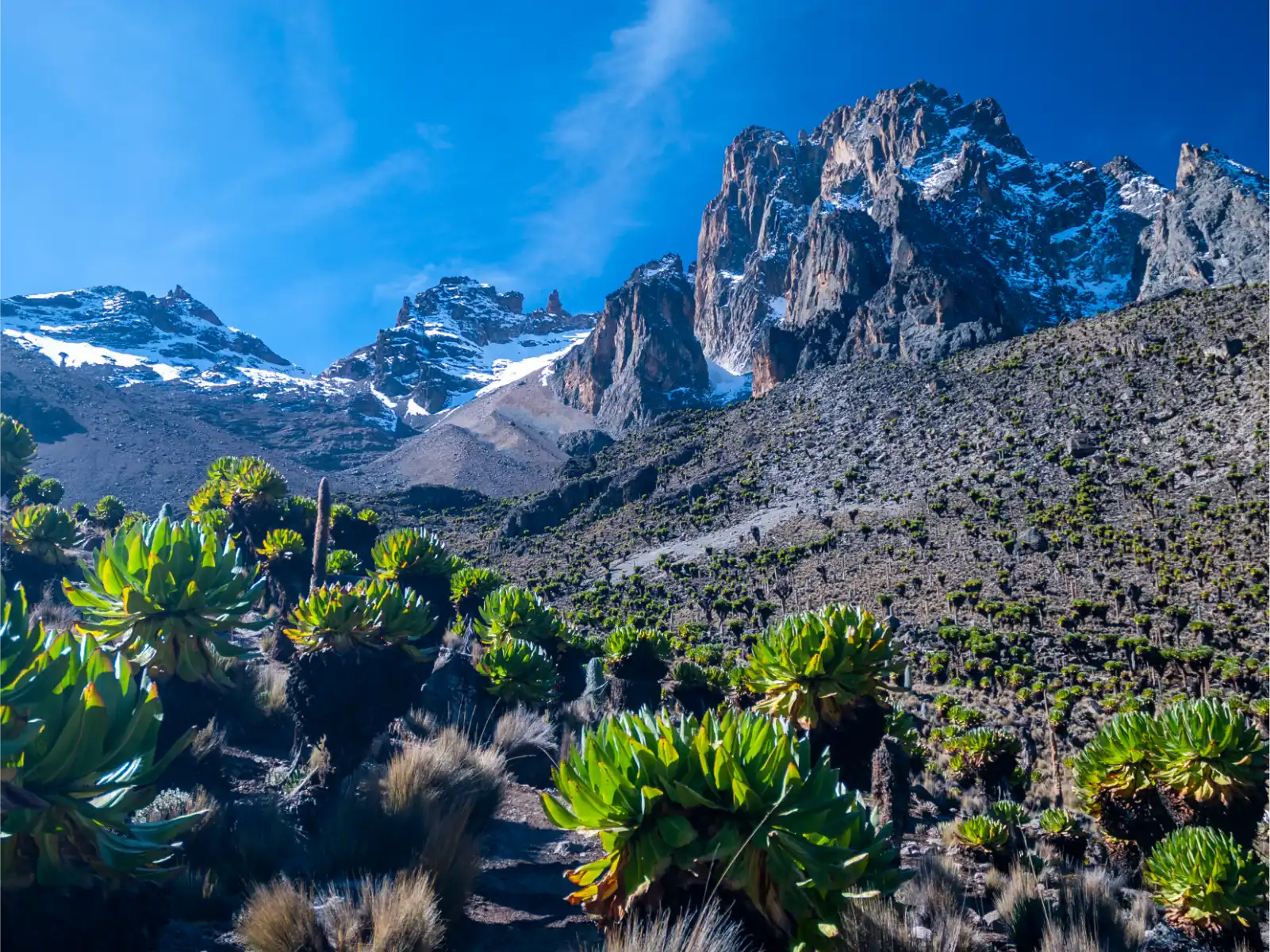
Mount Kenya hiking is one of the most rewarding mountain experiences in East Africa, and one of the most underestimated. Africa’s second-highest peak at 5,199 metres sits just 150 kilometres from Nairobi, inside a UNESCO World Heritage Site, and draws local and international trekkers year-round. Yet most people who come underprepared leave before reaching the top.
This guide covers everything you need before you book: routes and which suits your goals, the fitness level required, altitude realities, gear essentials, park fees, and the best windows to go. Whether you are planning a four-day circuit or a multi-day traverse, the information here applies directly.
What Makes Mount Kenya Different from a Standard Trek
Mount Kenya is not technical for most trekkers. The objective for the vast majority is Point Lenana at 4,985 metres — the highest non-technical summit on the massif. However, several things make this mountain distinctly challenging compared to a long-distance lowland trail. First, the elevation gain from the gate to the summit is steep and rapid. Second, the mountain sits on the equator, meaning weather can shift from warm sunshine to freezing sleet within the same afternoon. Third, the mountain harbours wildlife. Buffalo and elephant occupy the forest zones, and the upper moorlands are home to leopard, rock hyrax, and several bird species found nowhere else in Africa.
Because of its altitude and pace, mount kenya hiking demands genuine cardiovascular preparation. The good news: the mountain is achievable for fit, well-prepared trekkers of all ages.
The Three Main Routes — and One Outstanding Combination
Three routes handle around 90% of all trekkers on the mountain. Each starts from a different compass point, passes through different landscapes, and suits a different trekker profile. Solo and group itineraries can run any single route as a return, but the most rewarding approach combines two.
Sirimon Route — Best for Acclimatization and Comfort
The Sirimon Route approaches from the northwest, near Nanyuki, and offers the most gradual ascent on the mountain. It is currently the most popular route. The trail passes through yellow and rosewood forest before opening into vast moorlands filled with giant lobelias and senecios — the strange, otherworldly plants that define Mount Kenya’s high-altitude landscape. Key overnight stops include Old Moses Camp at 3,300 metres and Shipton’s Camp at 4,200 metres.
The gradual elevation profile makes Sirimon the best choice for acclimatization. Trekkers typically complete it in four to five days. It is strongly recommended for first-time high-altitude hikers and for anyone doing their first mount kenya hiking experience.
Read the full details on our Sirimon Route trek page.
Chogoria Route — The Scenic Choice
The Chogoria Route approaches from the east and is widely regarded as the most visually spectacular path on the mountain. It starts near Chogoria town and climbs through dense bamboo and rainforest before reaching the high moorlands. The route passes Lake Ellis at 3,455 metres, then Lake Michaelson — one of the most dramatic alpine lakes in Africa — before arriving at Mintos Hut at 4,200 metres. The Gorges Valley and the Temple Cliffs section deliver views that set this route apart from any other on the mountain.
Chogoria takes four to six days and suits trekkers who can pace themselves over longer stages. It is the preferred choice for photographers and hikers who want the full visual range that Mount Kenya has to offer.
See our full Chogoria Route trip page for itinerary details.
Naro Moru Route — Fastest to the Summit
The Naro Moru Route runs up the western face and is the shortest, most direct path to Point Lenana — typically completed in three to four days. It is the route of choice for experienced trekkers with limited time and good altitude tolerance. The defining feature is the Vertical Bog: a steep, muddy section through tussock grassland that tests endurance and footing, particularly during wet conditions. The final approach to the summit passes Austrian Hut and includes fixed ropes along the exposed summit ridge.
Because of its pace, the Naro Moru carries a higher rate of altitude-related difficulties than Sirimon or Chogoria. It is not the right choice for first-time high-altitude trekkers.
The Chogoria-Sirimon Traverse — The Best Complete Experience
The traverse combining Chogoria ascent with Sirimon descent is widely considered the definitive mount kenya hiking experience. You gain elevation through Chogoria’s exceptional eastern scenery, reach the summit, then descend via Sirimon’s comfortable northwestern slopes. The full traverse takes five to six days and delivers the broadest cross-section of the mountain — different flora, different geology, and different camps on each side.
For most trekkers with five or more days, this is the combination TripGenius recommends.
Which Summit Are You Targeting?
Mount Kenya has three main peaks. Your choice determines the preparation level and skills required.
Point Lenana — The Trekking Summit
Point Lenana at 4,985 metres is the objective for the vast majority of visitors. No technical climbing skills are needed. The final ascent involves steep rocky terrain and loose scree, but no ropes, harnesses, or technical equipment. The summit push begins at around 2am from Shipton’s Camp or Mintos Hut, timed to reach the top at sunrise. That combination — near-5,000 metres elevation, darkness, and predawn cold — is what demands your physical preparation.
Batian and Nelion — Technical Peaks
Batian (5,199m) and Nelion (5,188m) are the true summits of Mount Kenya. Both require full rock climbing competence: exposed ridges, multi-pitch climbing, and a serious commitment to the objective. Only around 50 climbers reach Batian in a typical year. If you are targeting either technical peak, specialist instruction and certified climbing guides are non-negotiable. This guide covers context and background — it does not substitute for a technical preparation programme.
How Fit Do You Need to Be for Mount Kenya Hiking?
Mount kenya hiking to Point Lenana is not a stroll. You will cover significant distances on uneven terrain over consecutive days at elevations where each breath delivers less oxygen than at sea level. The trekkers who struggle most are not the unfit ones — they are those who arrive under-conditioned and push too hard in the first 48 hours on the mountain.
Begin training at least two to three months before your trek. If you are starting from a low base, give yourself four to six months.
Build Your Aerobic Base
Cardiovascular fitness is the foundation of mount kenya hiking preparation. Running, cycling, swimming, and brisk uphill walking all build the aerobic engine needed for sustained multi-day effort. Aim for four to five sessions per week of 40 to 60 minutes each. Work at sustained moderate intensity, not sprint pace. Build both duration and challenge progressively. Ease off two weeks before your trek to arrive recovered.
Leg Strength and Stability
The long descents on Mount Kenya — particularly the rocky Chogoria sections — place significant load on your quadriceps and knees. Add squats, step-ups, lunges, and calf raises to your weekly routine. Core strength improves balance on boulder fields and uneven moorland. Two strength sessions per week alongside your aerobic work is a sustainable structure.
Practice Hikes: Essential, Not Optional
Nothing replicates a mountain day better than time on a hill. From eight weeks before your trek, schedule a three to six hour hike every fortnight with a loaded daypack of 5 to 6 kg. Train in the boots you will wear on the mountain. This breaks in your footwear, identifies any fit problems early, and builds the specific muscular endurance that flat-road running does not develop.
Altitude: What to Expect and How to Manage It
Altitude is the defining variable in any mount kenya hiking attempt. Point Lenana sits at just under 5,000 metres. Above 3,000 metres, atmospheric oxygen drops significantly — each breath delivers less than it would at sea level, and your body works harder for every step. Your body responds by producing more red blood cells over time, but that process takes days. Ascending too fast is what causes Acute Mountain Sickness, known as AMS.
Mild AMS produces headache, nausea, fatigue, and disrupted sleep. These symptoms are common above 3,500 metres and do not always require descent. Severe AMS — breathlessness at rest, loss of coordination, or confusion — requires immediate descent and medical attention. Your licensed guide monitors your condition throughout and will apply the standard protocol if symptoms escalate.
Three things consistently improve your outcome. First, choose a route with enough days — four is the minimum, five is better, and the Chogoria-Sirimon traverse at five to six days is best. Second, apply “climb high, sleep low” where the itinerary allows. Third, walk slowly. Pace on Mount Kenya is a strategy, not a comfort choice. Drink three to four litres of water per day. Dehydration accelerates altitude symptoms and is entirely preventable.
Essential Gear for Mount Kenya Hiking
Mount Kenya’s climate zones demand the same layered approach as any serious alpine environment. Temperatures at the base range from 15°C to 25°C. At the summit, they drop to -10°C or lower — combined with wind and, in some seasons, ice and snow on the final approach. Wrong gear ends mount kenya hiking attempts before altitude does.
Clothing: The Three-Layer System
Your base layer wicks moisture away from the skin. Merino wool and quality synthetic fabrics both perform well across wet forest sections and dry moorland. Your mid layer provides insulation — a fleece jacket or lightweight down piece. Your outer layer is waterproof and windproof; Gore-Tex or a comparable breathable shell is the standard for the summit push and any afternoon rain at altitude. Also pack thermal base layer bottoms, waterproof overtrousers, a warm beanie, a balaclava for the 2am summit start, liner gloves inside insulated mittens, and a wide-brimmed hat for the forest and moorland sections.
Boots, Poles, Sleeping Gear, and Daily Essentials
Your boots must be waterproof, ankle-supporting, and broken in before day one. Mount Kenya’s terrain ranges from muddy forest paths to loose scree and rocky ridges — both demand grip and ankle stability. Start wearing your trek boots on practice hikes at least two months out. Trekking poles reduce knee strain on descents and improve balance on boulder sections. Gaiters are strongly recommended for the Vertical Bog on Naro Moru and for any route in wet conditions.
Your sleeping bag should be rated to at least -10°C for comfort. Camp temperatures at Shipton’s and Mintos Huts regularly drop below this. Porters carry your main duffel — most operators cap this at 15 kg, soft-sided only. Your daypack of 15 to 20 litres carries daily essentials: two litres of water in an insulated bottle, trail snacks, a headlamp with spare batteries, waterproof layers, warm hat and gloves, sunscreen rated SPF 50, and UV-rated sunglasses.
When to Hike: Mount Kenya’s Best Seasons
The best months for mount kenya hiking are January, February, June, July, August, September, and October. These periods fall within the mountain’s two dry seasons and offer stable weather, clearer skies, and the best trail conditions.
January and February are excellent: warm at lower elevations, clear summit views, and fewer trekkers than the mid-year peak. June through October is the busiest window — and for good reason. Conditions are reliable, the moorland is dry and navigable, and summit visibility is at its best. The long rains in April and May are the period to avoid as a first-timer. Trails become muddy and slippery, the Vertical Bog on Naro Moru becomes genuinely difficult, and cloud cover can close in for days. November’s short rains are lighter but still affect the lower forest sections. Mount Kenya is open year-round, but within the dry windows is where preparation meets optimal conditions.
Park Fees and Total Budget
All mount kenya hiking inside the National Park requires a KWS entry permit. Effective October 1st, 2025, the non-resident adult park entry fee is USD 70 per person per 24-hour period, increased from the previous USD 52 under the Wildlife Conservation and Management (Fees) Regulations 2025. The fee applies regardless of your entry gate — Sirimon, Naro Moru, or Chogoria. Tickets are purchased online via the KWS eCitizen platform or arranged through your licensed operator. Solo hiking is not permitted inside the park — all trekkers must be accompanied by a licensed guide.
For a five-day Chogoria-Sirimon traverse with a reputable operator in 2026, expect to pay between USD 800 and USD 1,300 per person depending on group size. The Sirimon return over five days runs from around USD 700 for a group. Budget packages for four-day routes start from approximately USD 600. These prices typically include all park fees, a certified guide, porters, a mountain cook, all meals on the mountain, and camping or hut accommodation. Travelling in a group of three or more reduces the per-person rate considerably.
For current permit fees and booking, visit the Kenya Wildlife Service official website.
Getting to Mount Kenya
The mountain sits approximately 150 kilometres north of Nairobi — a three to four hour drive. The main staging towns are Nanyuki for the Sirimon route and Chogoria town for the Chogoria approach. Most operators include return transfers from Nairobi in their packages. If you are arranging independent transport, regular services run from Nairobi along the A2 highway toward Nanyuki.
International visitors arrive through Jomo Kenyatta International Airport (NBO) in Nairobi. Kenya’s eTA (electronic Travel Authorisation) is required for most nationalities. Apply via etakenya.go.ke before departure. The fee is approximately USD 34 including service charges, and processing takes three working days. African nationals from most countries have been visa-free for stays of up to 60 days since Legal Notice 93 of May 2025.
Plan Your Mount Kenya Hiking Trip with TripGenius Travel
TripGenius Travel arranges guided mount kenya hiking packages across all main routes — Sirimon, Chogoria, Naro Moru, and the Chogoria-Sirimon traverse. Every package covers a licensed and certified mountain guide, all KWS park fees, a dedicated mountain cook, porters, full-board meals on the mountain, and hut or camping accommodation throughout.
Mount Kenya pairs naturally with a Kenya wildlife extension. Many trekkers come off the mountain and head directly into a Nairobi safari circuit — Amboseli National Park offers views of Kilimanjaro from the plains, while the Maasai Mara delivers the Big Five within a few hours of Nairobi. We connect the mountain and the safari into one itinerary with no gaps.
Get in touch to discuss your route, your preparation questions, and the right timing for your schedule.
Final Word
Mount Kenya is Africa’s own high-altitude adventure — closer to Nairobi than most people realise, genuinely challenging, and visually unlike anything else on the continent. The mountain rewards preparation and punishes shortcuts. Book a route with enough days, build your aerobic base, bring a sleeping bag rated for cold, and walk slowly above 4,000 metres.
The sunrise from Point Lenana — Africa spread out below you, Kilimanjaro visible 300 kilometres to the south on a clear morning — is a view that earns its approach.