
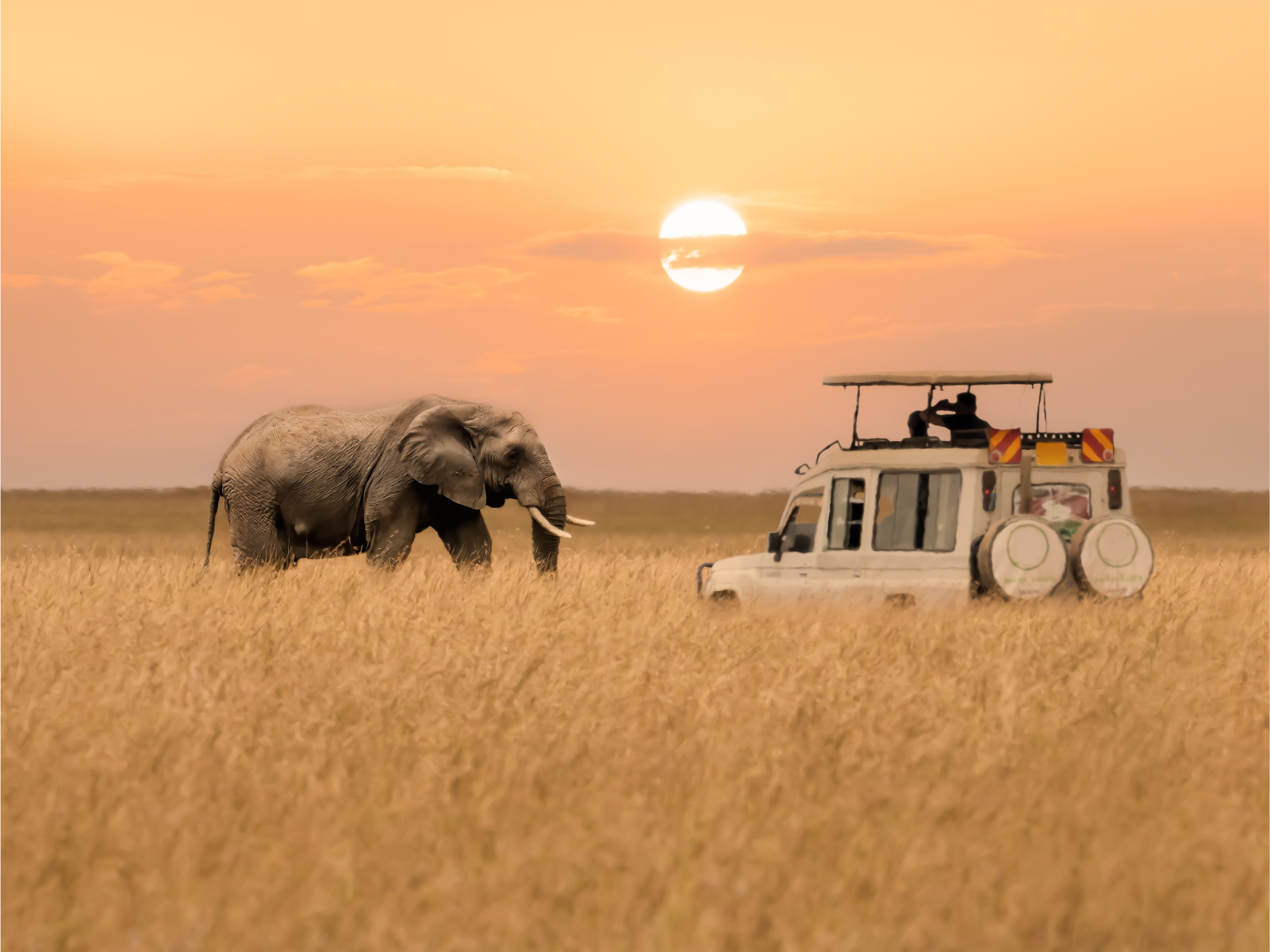
The Maasai Mara vs Serengeti debate comes up in almost every East Africa safari conversation — and for good reason. These two reserves sit on opposite sides of the Kenya-Tanzania border, separated by a river and a fence line, yet they offer genuinely different safari experiences. The honest answer is that both are world-class. But the right choice depends on when you travel, what you want to see, and how much you are prepared to spend. This guide breaks down every factor — migration timing, park fees, access logistics, visa requirements, and crowd levels — so you can make the decision with confidence rather than guesswork.
Two Reserves, One Shared Ecosystem
Before getting into the Maasai Mara vs Serengeti comparison point by point, it helps to understand what connects them. These are not two separate wildlife destinations — they are two ends of one continuous ecosystem. The Serengeti spreads across roughly 14,750 square kilometres of northern Tanzania. The Maasai Mara sits directly north of it in Kenya, covering around 1,510 square kilometres of national reserve land, with private conservancies on its borders adding significantly more space.
Together, the Serengeti-Mara ecosystem supports one of the densest concentrations of large mammals on earth, sustained by seasonal rainfall patterns that drive the most famous animal movement in the natural world.
The key difference between them is scale. The Serengeti is vast in a way that changes your experience of the landscape — you can drive for hours and feel like you have the place entirely to yourself. The Maasai Mara is smaller and more concentrated, which makes wildlife easier to find, especially during peak migration months when game density is extreme. Neither quality is better than the other; they are simply different kinds of safari.
For a detailed look at the reserve itself, explore our Maasai Mara National Reserve destination guide.
The Great Migration: Timing Is Everything
The Great Migration is the primary reason most travellers are weighing up the Maasai Mara vs Serengeti question. Over 1.5 million wildebeest, joined by hundreds of thousands of zebras and gazelles, make a year-round clockwise circuit through the Serengeti-Mara ecosystem, following seasonal rains and fresh grass. The circuit is continuous — the migration never actually stops — but the spectacle changes dramatically depending on where the herds are in the calendar.
Getting the timing right is the single most important decision in planning your trip, so here is exactly what happens month by month.
January to June — The Serengeti’s Season
The year begins in the southern Serengeti, particularly around the Ndutu Plains near the Ngorongoro border. January through March is calving season. Roughly 500,000 wildebeest calves are born in a compressed window, flooding the short-grass plains with newborns and drawing predators in extraordinary numbers. Lions, cheetahs, and hyenas are in near-constant motion. Witnessing a cheetah hunt on the open Ndutu plains during calving season is one of the most intense wildlife experiences available anywhere in Africa.
This phase belongs entirely to Tanzania. If you travel between January and March and are choosing between Maasai Mara vs Serengeti, the Serengeti is the clear answer — the Mara simply does not have the calving spectacle.
By April and May, the long rains fall and the herds begin their slow northward push through the central Serengeti. Game viewing remains strong, but vehicle tracks and access roads become harder to navigate. June and early July bring the first major drama of the season: the Grumeti River crossings in the western corridor. The Grumeti is often overshadowed by the more famous Mara River, but it hosts some of the largest Nile crocodiles in Africa and produces crossings that are every bit as intense as what happens further north.
July to October — The Mara’s Moment
When the herds push north into Kenya, the Maasai Mara enters its peak season. The Mara River crossings — wildebeest plunging into crocodile-filled water in panicked waves — typically peak in August, though crossings can occur any time from late July through September. The timing is not predictable to the day, but August has the highest probability of a major crossing event.
The Mara’s compact size works in your favour here. Game concentrations during July to October are extraordinary, and the reserve’s high predator density — particularly lion and cheetah — means even non-crossing days produce exceptional sightings. If the primary goal is witnessing the Mara River crossings, the Maasai Mara from July to October is the stronger bet in any Maasai Mara vs Serengeti decision.
November to December — The Return South
By late October, the short rains return to Tanzania and the herds begin moving south again, recrossing the Mara River before dispersing across the Serengeti. November and December offer quieter, greener game viewing with far fewer vehicles in the parks, lower accommodation rates, and landscapes that photograph beautifully after the rains. If solitude and value matter to you, these months are underrated in both destinations.
Wildlife Beyond the Migration
The Maasai Mara vs Serengeti choice should not be driven solely by migration timing. Both reserves offer Big Five sightings year-round, but the wildlife experience differs in meaningful ways.
The Maasai Mara has one of the highest densities of large predators in Africa. Lion prides are frequently encountered, and the reserve consistently produces strong cheetah sightings. Crucially, the Mara is one of the few places in Kenya where you can reliably see the black rhino — the most difficult member of the Big Five to find across East Africa. If completing the Big Five is a priority on your trip, this matters. Elephants are also a regular presence in and around the reserve, as are hippo pods along the Mara River.
The Serengeti operates at a different scale of wildlife diversity. Its enormous size supports larger elephant herds across wider territory, and the Seronera Valley area is one of the best places in East Africa for leopard sightings — the tree-climbing cats are well-habituated to vehicles and regularly photographed in full view. The Serengeti also has strong lion populations, particularly in the central Seronera and northern Lobo areas.
One important distinction: the Serengeti has no black rhino within its boundaries. Rhino encounters in Tanzania are almost entirely confined to the Ngorongoro Crater, which sits south of the Serengeti and is typically visited as part of a combined northern circuit safari.
Park Fees and What You Will Actually Pay
The cost difference between Maasai Mara vs Serengeti is more nuanced than it first appears. Both destinations carry premium entry fees, but they structure their charges differently — and the total cost depends heavily on when you travel.
Maasai Mara Fees 2026
Non-resident adults pay USD 100 per person per day from January to June, and USD 200 per person per day from July to December. These rates are set by Narok County Government, which manages the Maasai Mara National Reserve, and they are among the highest single-day park fees in Africa during peak season. Children aged 9 to 17 pay USD 50 year-round. Children under 8 enter free.
One critical detail that catches many visitors off guard: the Mara uses a 12-hour ticket, valid from 6 AM to 6 PM. This is unlike standard KWS national park tickets, which run for 24 hours. If you exit the reserve after 10 AM on your departure day, you may be charged for an additional full day. Confirm this with your operator when planning your drive-out schedule.
East African residents — covering Kenya, Uganda, Tanzania, Rwanda, and Burundi — pay significantly reduced rates in Kenya Shillings. Kenyan citizens have access to the most affordable tier.
Serengeti Fees 2026
Non-resident adults pay USD 70 per person per day during peak season (May 16 to March 14) and USD 60 per person per day during low season (March 15 to May 15). These fees come with an additional 18% VAT applied by Tanzania on all park charges — sometimes included in quoted prices, sometimes not. Always confirm with your operator whether VAT is in or out of the number you are looking at.
Travellers staying overnight inside the Serengeti at a lodge or tented camp are also liable for a concession fee of USD 60 per adult per day during peak season. When you combine daily park fees, concession fees, and VAT, a high-season Serengeti lodge stay can match or exceed the Mara’s USD 200 peak rate once all charges are totalled.
For current fee schedules from both authorities, refer to the Kenya Wildlife Service for Mara-area parks and the Tanzania National Parks (TANAPA) for the Serengeti.
Getting There: Access and Logistics
On the Maasai Mara vs Serengeti access question, the Mara wins clearly for most travellers — particularly those routing through Nairobi.
The Maasai Mara is genuinely easy to reach. From Jomo Kenyatta International Airport, a short transfer takes you to Wilson Airport, Nairobi’s domestic hub. From there, AirKenya, Safarilink, and Mombasa Air Safari operate multiple daily flights to Mara airstrips in around 45 minutes. One-way fares typically run USD 150 to USD 250. For those who prefer to drive, the road journey from Nairobi takes around five to six hours, with the final stretch on murram roads. The drive is manageable but demanding.
The Serengeti involves a longer, more complex journey. Most international visitors fly into Kilimanjaro International Airport or connect through Nairobi, then transfer to Arusha — the staging point for northern Tanzania safaris. From Arusha, a domestic bush flight to Serengeti airstrips such as Seronera, Kogatende, or Grumeti takes one to two hours. Driving from Arusha to the Serengeti takes eight or more hours and passes through the Ngorongoro Conservation Area, which has its own separate entry fees.
The additional travel time to the Serengeti becomes a real consideration on shorter trips. If you have five days total, spending a day and a half in transit each way significantly cuts into game drive time. The Mara’s proximity to Nairobi means you can be on a game drive within two hours of landing internationally.
One important note if you plan to do both: you cannot cross the Kenya-Tanzania border between the Mara and Serengeti through an informal tourist point. All crossings must go through an official border post, which adds considerable journey time. Most travellers do each park on separate trips or fly via Nairobi or Kilimanjaro between them.
Visas and Entry Requirements
The Maasai Mara vs Serengeti decision also involves two separate visa processes if you are crossing both countries.
For Kenya: most international visitors apply for an Electronic Travel Authorisation online at etakenya.go.ke. The total fee is approximately USD 34 (USD 30 base fee plus a service charge), with standard processing taking around three working days — allow longer during peak periods. As of May 2025 under Legal Notice 93, African nationals (with the exception of Libya and Somalia) are visa-free for Kenya for stays of up to 60 days.
For Tanzania: most nationalities apply for an eVisa through the Tanzania Immigration Services portal before travel. A single-entry tourist visa costs USD 50 for most nationalities. US citizens are required to obtain a multiple-entry visa, which costs USD 100. Yellow fever vaccination documentation is required if you are travelling from a country considered to have a risk of yellow fever transmission.
If you plan to visit Kenya and Uganda in the same trip, the East Africa Tourist Visa covers both countries plus Rwanda for USD 100. Tanzania is not part of the EATV arrangement, so a separate Tanzania eVisa is always required regardless of your other East Africa itinerary.
Crowd Levels and the Safari Atmosphere
Both parks attract significant visitor numbers during peak season, but the experience of crowds differs considerably.
The Maasai Mara can feel genuinely congested during August and September at the Mara River crossing points. When a crossing begins, vehicles converge rapidly. If solitude and a quieter experience matter to you, booking a camp in one of the private conservancies bordering the main reserve — Olare Motorogi, Naboisho, Mara North, or the Mara Triangle — gives you far fewer vehicles on your game drives. Conservancy camps also permit walking safaris and night drives, which are not allowed inside the main reserve.
The Serengeti, given its scale, absorbs visitors far more easily. Migration crossing points near Kogatende in the northern Serengeti do attract concentrated crowds during peak months, but driving an hour in any direction typically puts you in near-empty wilderness. The variation in atmosphere across the Serengeti’s different zones — the intimate Ndutu plains, the wildlife-dense Seronera Valley, the remote Lobo area in the north — is one of the destination’s genuine strengths.
Maasai Mara vs Serengeti: A Straight Answer
If you need to make a decision, here is exactly how to think about Maasai Mara vs Serengeti based on your situation.
Go to the Maasai Mara If
You are travelling between July and October and specifically want the Mara River crossing experience. You want easy, quick access from Nairobi with minimal travel time. You want the best chance of Big Five sightings — particularly black rhino. You are on a shorter trip of four to five days and need high-density wildlife encounters from day one. You want to combine your safari with Kenya’s coast, Amboseli, or other Kenyan destinations without leaving the country.
Go to the Serengeti If
You are travelling between January and March and want to witness calving season in the Ndutu Plains — one of the most intense predator-and-prey spectacles on the planet. You want to combine the Serengeti with Ngorongoro Crater and Tarangire for the full Tanzania northern circuit. You prefer vast, open landscapes and the sense of being genuinely remote. You have seven or more days and want to cover multiple zones of the park. You are planning to extend your trip to Zanzibar or Kilimanjaro as a follow-on.
Plan Your Trip with TripGenius Travel
A Maasai Mara vs Serengeti safari that actually delivers what you came for requires the right camp selection, precise timing, and an operator who knows both ecosystems. TripGenius Travel builds East Africa safari packages across both destinations — from short fly-in Mara experiences of four days to ten-day Tanzania northern circuit journeys combining the Serengeti, Ngorongoro Crater, and Zanzibar.
Browse our Maasai Mara packages and Serengeti itineraries to start building your trip. Our team is ready to help you plan from the ground up — migration timing, camp selection, budget structure, and everything in between.
Final Word
The Maasai Mara and the Serengeti share the same ecosystem, the same herds, and the same category of world-class safari experience. What separates them is timing, scale, access logistics, and fee structure. Neither is a wrong choice. But once you match your travel dates to the migration calendar and weigh up the access realities, the right answer for your specific trip becomes clear. Both reserves reward visitors who plan well. The Maasai Mara vs Serengeti decision is ultimately about knowing what you want — and booking early enough to get it.