
A great migration safari is one of those trips where the question isn’t whether to go — it’s how to plan around something nature flatly refuses to schedule.
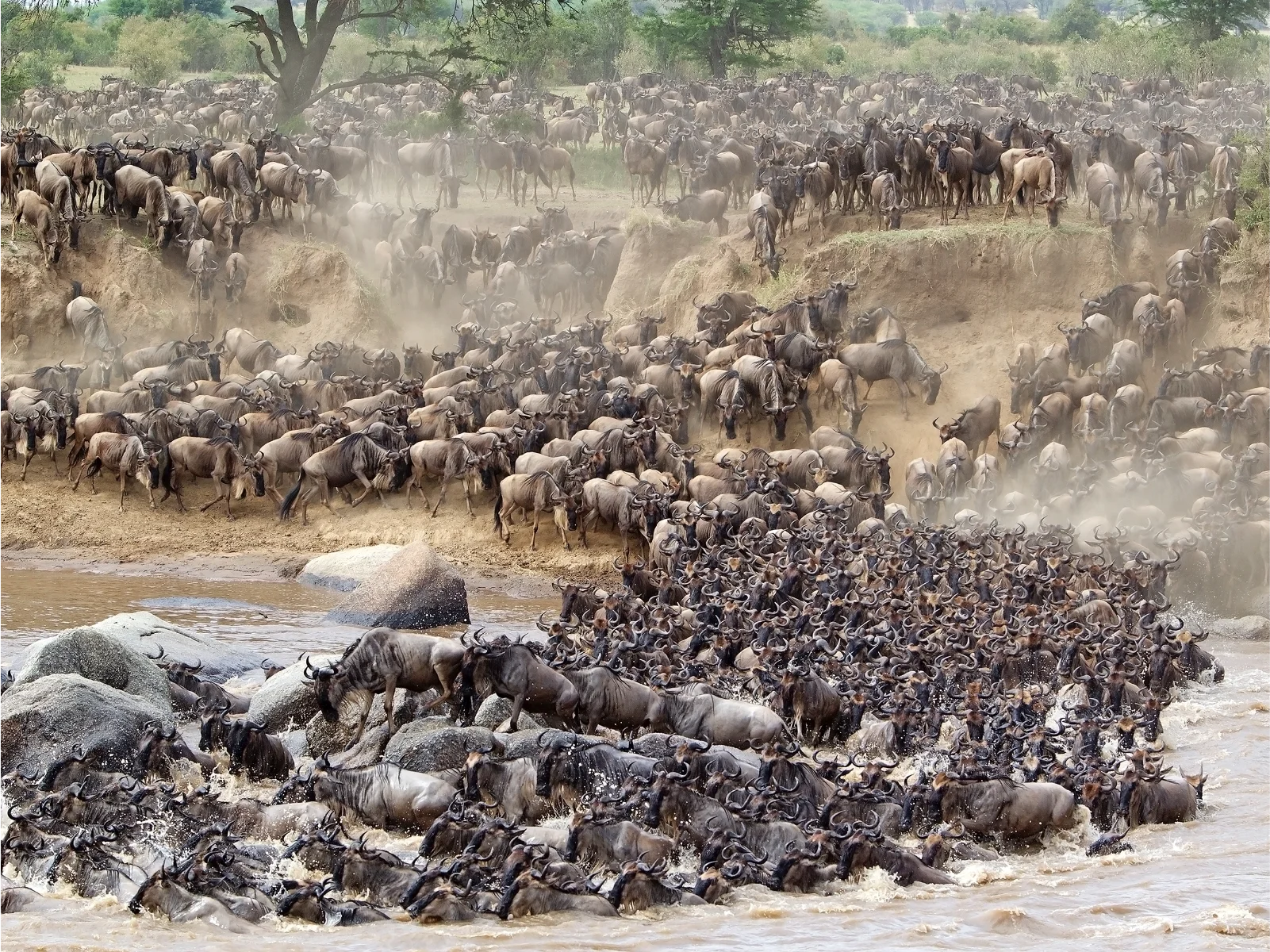
Every year, more than 1.5 million wildebeest, joined by hundreds of thousands of zebras and Thomson’s gazelles, make a continuous clockwise circuit through the Serengeti-Mara ecosystem across Tanzania and Kenya. The journey covers roughly 800 kilometres. Along the way, calves are born by the hundreds of thousands, rivers are crossed in desperate, crocodile-laced sprints, and around 250,000 wildebeest don’t make it back to the start of the loop.
If you’re building your entire East Africa trip around this event, this guide has everything you need. We cover the full year-round calendar, the specific months and locations that matter most, what the Mara River crossings actually look like on the ground, and how to structure an itinerary that gives you a real shot at witnessing one — not just a story of near-misses and empty riverbanks.
What Actually Is the Great Migration?
Most travellers use the term “Great Migration” to mean one thing: wildebeest crossing the Mara River. The reality is much bigger.
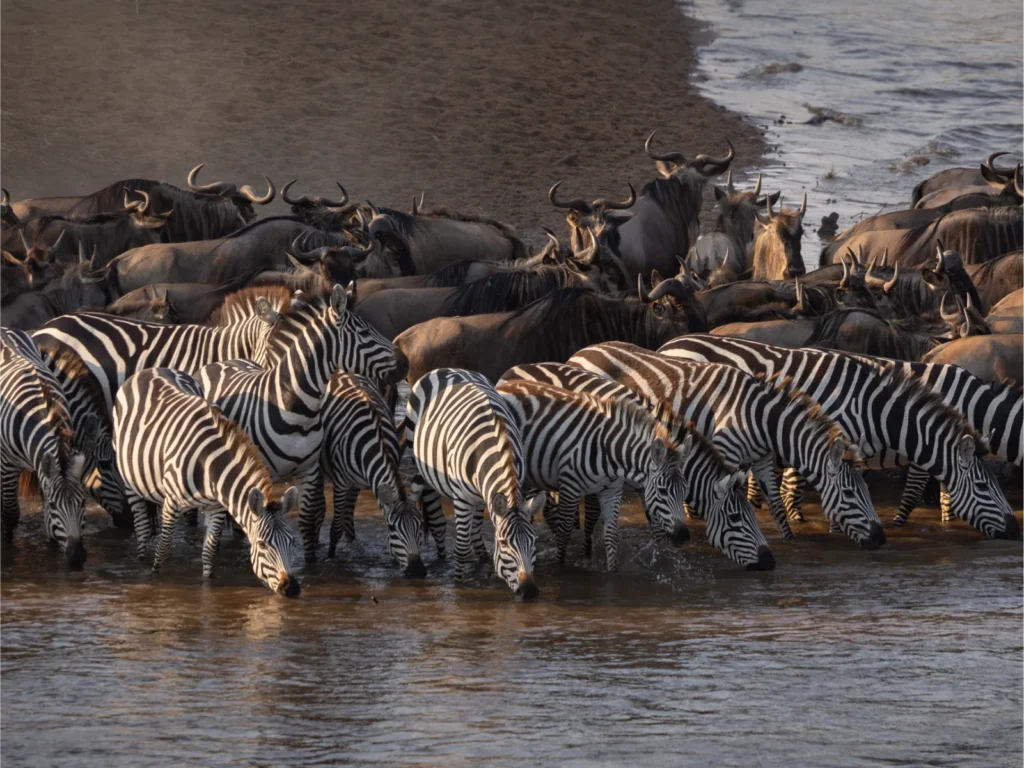
The great migration safari is a year-round movement, not an event with a fixed start and end date. It is a continuous loop, driven entirely by rainfall and the availability of fresh grass. The herds circle through the Serengeti-Mara ecosystem every single year — from Tanzania’s southern Serengeti plains north to Kenya’s Maasai Mara and back again. The direction is always clockwise. The timing shifts slightly each year based on when the rains arrive and depart.
UNESCO designated Serengeti National Park as a World Heritage Site in 1981, citing this migration as the largest remaining unaltered animal migration on Earth. The ecosystem it crosses spans over 30,000 square kilometres of protected savannah across two countries.
The headline numbers: over 1.5 million wildebeest, roughly 200,000 zebras, and around 500,000 Thomson’s gazelles are in motion at any given time. Around 250,000 wildebeest die during each annual cycle — from drowning, predation, exhaustion, and disease. Yet the population sustains itself through one of the most extraordinary survival mechanisms in the animal kingdom: synchronised mass calving.
The Migration Calendar: Month by Month
Understanding where the herds are each month is the foundation of any great migration safari plan. Whether you’re timing a great migration safari around the crossings, the calving, or simply the quietest months with the best value, the 12-month cycle is what everything else depends on. No single month covers everything, and no single park hosts the spectacle year-round.
January to March — Calving Season in the Southern Serengeti
The year begins in the south. Specifically, in the short-grass plains of Ndutu, near the boundary of the Ngorongoro Conservation Area, where volcanic ash soils produce the calcium-rich grass that lactating wildebeest mothers need for milk production.
From late January through March, roughly 500,000 calves are born — around 8,000 per day at peak calving. This extraordinary concentration of newborns triggers intense predator activity. Lions, cheetahs, hyenas, and wild dogs converge on the southern plains during these months. Calves that cannot keep pace with the herd are taken within minutes of birth.
Calving season is consistently underrated by first-time visitors who fixate on the river crossings. If dramatic predator-prey action is the priority, January through March in Ndutu and the southern Serengeti delivers it in ways that even the crossings don’t match. Accommodation rates are also significantly lower than peak season, and the southern Serengeti receives far fewer visitors than the Mara.
April to June — The Northward March
As the southern plains begin to dry, the herds start moving. They push into the central Serengeti through April and May, then continue northwest toward the Grumeti River by June and early July.
The Grumeti crossing is less famous than the Mara but no less dramatic. Giant Nile crocodiles inhabit these channels year-round, and the river requires the same terrifying commitment from the herd. Camps in the western Serengeti — particularly those around the Grumeti Reserves — offer excellent viewing during this phase, with significantly fewer vehicles than the August crowds in the north.
April is also the long rains season across much of East Africa. Accommodation rates are lower, but roads can be muddy and some camps close for maintenance. The trade-off can be worth it for budget-conscious planners willing to accept slightly rougher conditions.
July to October — The Great Migration Safari Peak
This is the phase most planners are building toward. By late July, the bulk of the herds have pushed into the northern Serengeti and begun gathering near the Mara River — the boundary between Tanzania and Kenya. The pressure of the herds builds on the southern bank until something triggers the plunge.
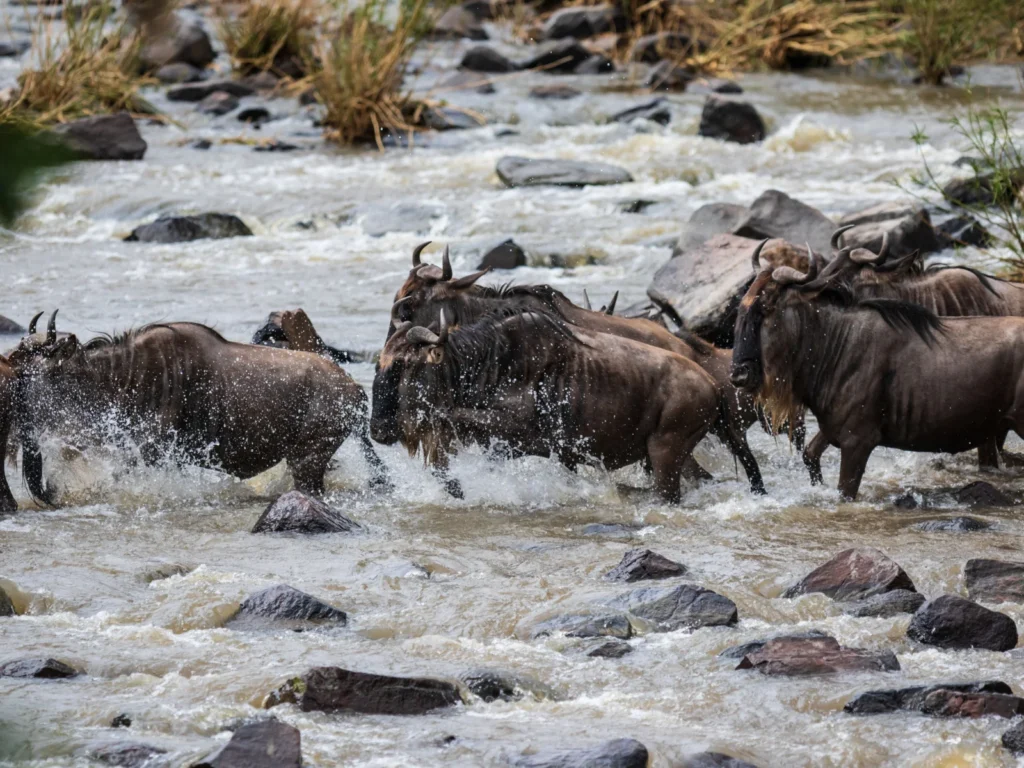
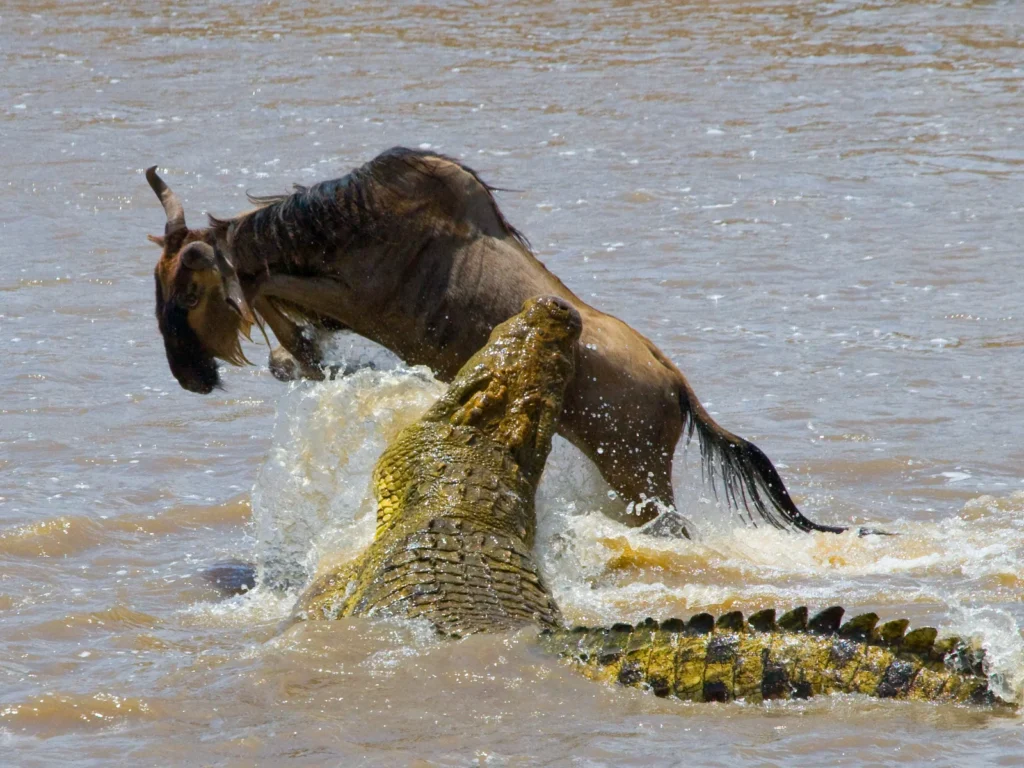
When a crossing begins, thousands of wildebeest charge into crocodile-filled water simultaneously. The noise, the dust, the motion — it can last 20 minutes or several hours. Crocodiles position themselves downstream and at the exit point on the far bank. Some wildebeest are taken. Most scramble up the far bank and scatter across the Mara grass.
The crossings are not a single daily event. Herds cross back and forth multiple times as rainfall patterns shift — north one day, south the next — meaning a single crossing point can see multiple events within a week. Observations from 2022, 2023, and 2025 confirm that herd arrival in the Mara remains broadly consistent from mid-July, with the most intense crossing windows in early August to early September. August is the highest-probability month. September offers comparable activity with noticeably fewer vehicles on the riverbank.
By late October, as the short rains begin in Tanzania, the herds sense the returning grass in the south. The southward return journey begins, and the Mara River is crossed again, this time heading back toward the Serengeti.
November to December — The Return South
Often overlooked, November and December involve the herds moving back through the central and eastern Serengeti toward the southern plains. The grass is still short from the dry season, visibility is excellent, and predator activity remains high. Accommodation rates drop considerably, and the parks thin out.
By December, the cycle is essentially complete. The herds are back in the south, the first calves are appearing, and the entire loop is ready to begin again.
The Mara River Crossing: What to Expect on the Ground
No photograph or documentary fully prepares you for a live crossing. The sound arrives first — the dust, the bellowing, the water — before the visual scale registers.
What typically unfolds: a vanguard group of wildebeest approaches the bank and turns back several times. The tension builds for minutes or even hours. Then one animal commits and jumps. Once the first wildebeest plunges in, the herd follows in a stampede that can put thousands of animals in the water simultaneously.
Crocodiles wait patiently. They strike in the water and at the exit bank. Some wildebeest are taken cleanly. Others escape by inches. The animals that make it across scatter onto the Mara grass and resume grazing within minutes, as if nothing happened.
There is no reliably predicting when a crossing will happen. Rangers and camp guides track the herds by radio and sometimes by helicopter, alerting vehicles when a crossing looks imminent. Even then, the herds routinely gather on the bank all morning and never cross. This is the core reason duration matters — three nights minimum in one crossing location is the threshold below which the probability of a live sighting drops sharply.
The primary crossing points in the Mara Triangle and in Kogatende on the Tanzania side are where vehicles position themselves. Camps within 15 to 20 minutes of the main crossings offer the best response time when the herds move.
Where to Be, and When
Maasai Mara National Reserve, Kenya
The Maasai Mara is the northern destination of the great migration safari and the primary stage for the Mara River crossings from July through October. The reserve is managed by Narok County Government and sits adjacent to a network of private conservancies — Olare Motorogi, Naboisho, Mara North, Ol Kinyei, and others — that together form the Greater Mara ecosystem.
For crossing season, the Mara Triangle and the areas directly adjacent to the primary crossing points are where you want to be. The best-positioned camps fill 12 to 18 months in advance for peak August and September dates. Booking late for high season is the most common avoidable mistake on a migration trip.
Year-round, the Maasai Mara holds exceptional resident wildlife. The reserve supports one of Africa’s densest predator populations, and the open savannah allows sightings that more forested parks cannot match.
Serengeti National Park, Tanzania
The Serengeti is where the migration spends the majority of its time. Different zones of the park host the herds at different points in the year. Ndutu in the south for calving season, the western Corridor for the Grumeti crossings, and the Kogatende and Lamai areas in the far north for Mara crossings from late July onward.
The northern Serengeti is frequently the less crowded alternative to the Kenyan side of the river. Camps on the Tanzania bank often provide more intimate viewing conditions, with fewer vehicles converging on each crossing event. Because this area is remote within the park, flying in is usually necessary — bush flights from Seronera or Kogatende airstrip connect easily from Arusha or Nairobi.
Private Conservancies: The Quiet Upgrade
The private conservancies surrounding the Maasai Mara operate under different rules from the national reserve. Night game drives are permitted. Off-road driving is allowed in most of them. Total guest numbers per property are strictly limited, meaning fewer vehicles at any given sighting.
Conservation fees in these conservancies typically run USD 80 to USD 150 per person per day and are usually bundled into all-inclusive camp rates. For migration season specifically, a conservancy camp with direct access to the Mara crossing points offers a significantly different experience from a mainstream national reserve camp — more time at the river, less noise, fewer interruptions. If budget allows, this is the upgrade that consistently produces better outcomes.
How to Build Your Itinerary Around the Migration
How Long Do You Actually Need?
Experienced safari guides consistently recommend a minimum of 10 to 14 days in-country if the migration is the primary goal. Within that, three nights minimum at any single crossing location is the baseline below which river crossing sightings become genuinely unlikely.
The herds can gather on the riverbank for three consecutive days with no crossing whatsoever, then cross twice in a single morning. A one-night stay at a camp near the crossing points is essentially a gamble. Two nights improves the odds. Three or more nights makes a crossing sighting a realistic outcome rather than wishful thinking.
A practical structure for a combined great migration safari across Kenya and Tanzania: two to three nights in the northern Serengeti or Lamai area, transfer to the Maasai Mara or a conservancy for two to three nights, with transfer time accounted for on travel days. Combine the Tanzania leg with a stop at the Ngorongoro Crater — one of Africa’s most reliable Big Five destinations year-round — to add depth to the overall itinerary.
Flexibility Is Not Optional
The single biggest planning mistake on a migration trip is fixing your river crossing camp to a single date and booking just one night. If you have a hard outbound flight, build buffer days into the itinerary. If you have genuine flexibility, use it — it’s worth more than an upgraded tent.
The crossings happen on the wildebeest’s schedule. A camp with an experienced guide, a radio network tracking real-time herd movements, and enough time to respond when the herds start moving — that combination produces crossing sightings far more reliably than exact date precision. Plan for the conditions, not the calendar.
What the Great Migration Costs in 2026
Park fees are a substantial line item on any great migration safari budget, and they change on 1 July in the Maasai Mara — which happens to be exactly when peak season begins.
In the Maasai Mara National Reserve, the 2026 non-resident adult fee is USD 100 per person per day from January to June and USD 200 per person per day from July to December. The doubling is tied directly to the migration season. Entry operates on a 12-hour window (6 AM to 6 PM), so overnight stays inside the reserve require an additional daily fee for the subsequent period.
In Serengeti National Park, non-resident adults pay around USD 70 per person per day in park entry fees, as confirmed by TANAPA. Lodge concession fees for accommodation inside the park add approximately USD 60 per person per night during peak season (July to September).
Private conservancy fees run USD 80 to USD 150 per person per day and are typically included in all-inclusive camp rates rather than charged separately.
Camp rates during crossing season (August and September) range from around USD 300 per person per night at solid mid-range tented camps up to USD 2,000 or more per person per night at premium lodges in the best positions. These figures are per person, not per room.
Budget separately for internal bush flights — these save significant drive time and provide extraordinary aerial views of the plains, but come with a strict 15 kg luggage limit including hand baggage, and require soft-sided bags only.
Practical Things to Know Before You Go
Kenya entry requires an Electronic Travel Authorisation (eTA) for most nationalities. Apply through the official portal at etakenya.go.ke. The fee is approximately USD 34 (base fee plus service charge), and approval typically takes three working days under normal conditions. Nationals from most African countries have been visa-free for Kenya since May 2025 under Legal Notice 93 of 2025 — confirm your specific nationality at the portal.
Tanzania requires a separate eVisa. Single entry costs USD 50 for most nationalities; US and Irish passport holders pay USD 100. Apply before travel at the Tanzania immigration services portal.
On the ground: avoid blue and black clothing on game drives — tsetse flies are attracted to dark colours. Favour khaki, beige, olive, or tan. Camouflage clothing is illegal for civilians in Tanzania. Pack layers for early morning game drives — temperatures in both the Mara and Serengeti drop sharply at dawn regardless of the time of year.
Yellow fever vaccination is required if travelling from a yellow fever endemic country. Confirm malaria prophylaxis and any other medical requirements with a travel doctor at least six weeks before departure. The WHO travel health page is the authoritative starting point for current health advisories.
Plan Your Great Migration Safari with TripGenius Travel
TripGenius Travel builds East Africa safaris designed around the migration calendar. Whether you want to anchor your trip to the Mara River crossings in August, witness the raw drama of calving season in Ndutu, or combine both phases in a two-week circuit through Tanzania and Kenya, our team helps you choose the right camps, the right zones, and the right dates — well before the best positions fill up for the season.
We handle Kenya eTA and Tanzania eVisa logistics, TANAPA and Narok County park fee budgeting, internal bush flight booking, and the complete itinerary from Nairobi to the riverbank and back. No generic packages. No fixed group departures.
Reach out through our contact page or explore our East Africa safari packages to get started.
Final Word
The great migration safari is not a single moment. It is a year-round ecosystem event with multiple entry points — calving drama in January, Grumeti crossings in June, Mara River spectacle from August through September, and quieter but still exceptional wildlife action through October and November.
Three things consistently make or break the great migration safari: timing the visit to the right zone for the right season, staying long enough to let the herds come to you, and working with people who are tracking herd movements in real time.
Everything else — the camp, the vehicle, the photography — matters far less than those three.