
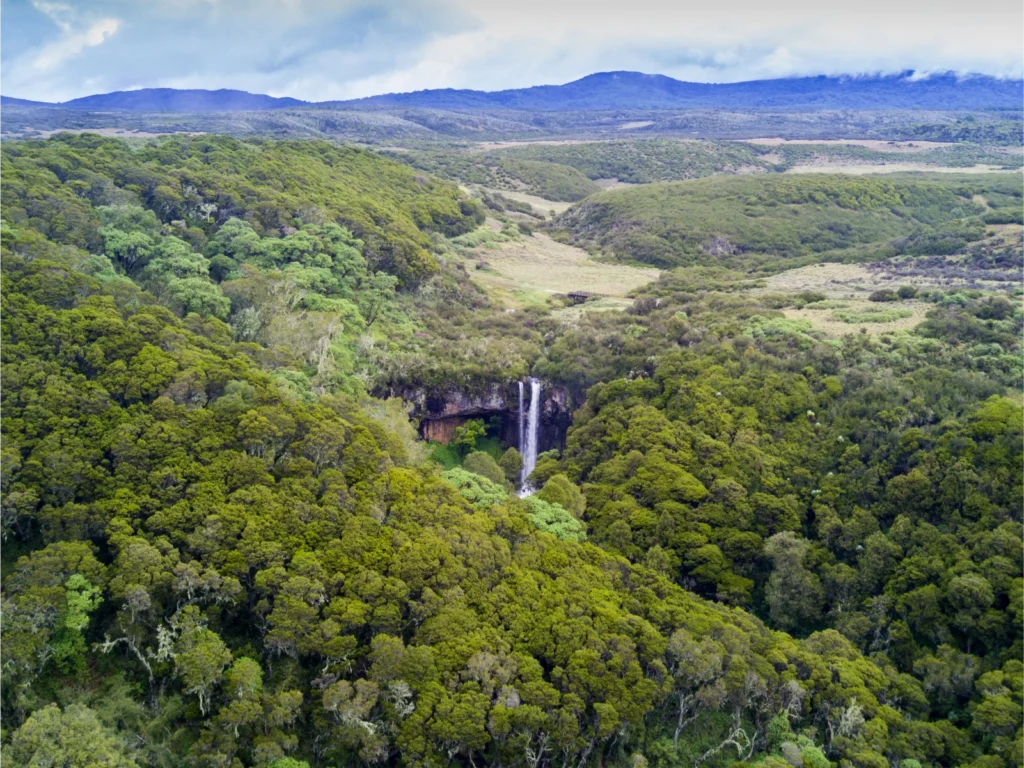
Aberdare National Park
1 trip
A specialist replies within 12 hours
Indicative prices, converted from US dollars. Your choice is remembered in this browser.
A forested mountain north-east of Nairobi with buffalo, colobus monkeys and a walk to the summit, close to the Fourteen Falls near Thika.
Ol Donyo Sabuk is a solitary, forest-covered mountain north-east of Nairobi near Thika; in the Kamba language it is called Kyanzavi. The national park around it was established in 1967 and is managed by the Kenya Wildlife Service.
A track and footpath climb through montane forest to the summit, where on clear days the views reach across the plains towards Mount Kenya and Kilimanjaro. Buffalo are common in the forest, so walkers go with a ranger; black-and-white colobus and Sykes's monkeys live in the trees, and the forest is good for birds. Near the summit is the grave of Sir William Northrup McMillan, an American settler who farmed below the mountain in the early twentieth century.
The Fourteen Falls on the Athi River, a short drive away, make a natural pair with the park on a day out from Nairobi. For other hikes close to the city, see the Ngong Hills, Mount Longonot and hiking and trekking in Kenya.
From day hikes on Rift Valley volcanoes to multi-day treks on Mount Kenya and technical climbs of its summits: where to walk in Kenya, how hard it is…
Best time July to September and December to February
Mild and often misty on the forested summit; the dry months make for clearer views over the plains.
-1.0827,37.2489
Entry rules and fees for Ol Donyo Sabuk National Park, from the authority that sets them.
Information changes. Always verify with the official portal. We link to it directly, never to third-party visa sites.
1 trip
4 trips
Tailor-made
Tailor-made
Free quote. No commitment. Tell us your dates, a rough budget and who is coming.
TripGenius travel experts
We reply within 12 hours.
Shape your trip in 3 taps